

Introduction
How to make study notes for exams is an important question for students who want to understand their subjects, remember key information, and prepare more effectively for tests. Well-organized study notes make difficult topics easier to review and help students focus on the information that matters most.
The best study notes are not copies of entire textbooks. Instead, they summarize important concepts, explain difficult ideas in simple language, and highlight definitions, formulas, examples, and likely exam questions.
Whether you are preparing for school tests, college examinations, university finals, or competitive exams, you can improve your study routine by learning a few practical note-making techniques.
In this guide, you will discover how to make effective study notes, choose the right format, organize information by subject, avoid common mistakes, and use your notes for better exam revision.
What Are Study Notes?
Study notes are organized summaries of important information from textbooks, classroom lessons, lectures, and other learning materials. They help students review a subject without repeatedly reading every page of the original material.
Effective study notes usually include:
- Important definitions and concepts.
- Key facts, dates, names, and formulas.
- Short explanations in your own words.
- Relevant examples and diagrams.
- Important questions and answers.
- Topics that require additional revision.
For example, if you are studying photosynthesis, you do not need to copy an entire chapter. You can write a short definition, list the materials plants need, explain the process, and include a simple diagram.
The goal is to make the information easier to understand and recall when you sit for an exam.
Why Is Making Study Notes Important?
Making study notes helps students organize information, identify important concepts, and prepare for examinations more systematically. When notes are combined with practice questions and regular revision, they can become a valuable part of an effective study routine.
1. Makes Difficult Topics Easier to Understand
Writing an idea in your own words encourages you to process its meaning instead of simply copying sentences from a book.
If a concept is difficult, break it into smaller points and add an example. This makes the information easier to review later.
2. Saves Revision Time
Concise notes allow you to revisit important information without reading an entire chapter again.
For instance, a long chapter on the human digestive system might be summarized using a labeled diagram, a list of organs, and a few lines explaining each organ’s function.
3. Helps Identify Knowledge Gaps
While making notes, you may discover that you cannot explain a particular concept clearly. This indicates that you need to revisit the textbook, ask your teacher, or practice more questions.
Identifying these gaps early gives you time to address them before the examination.
4. Supports Active Recall
Active recall means trying to retrieve information from memory without looking at the answer.
You can use your notes to create questions, cover the explanations, and test yourself. This is generally more useful for checking understanding than repeatedly reading the same material without testing yourself.
5. Improves Organization
Separate notes for each subject and chapter help you locate information quickly. A consistent format also makes it easier to compare related concepts and recognize connections between topics.
How to Make Study Notes for Exams Step by Step
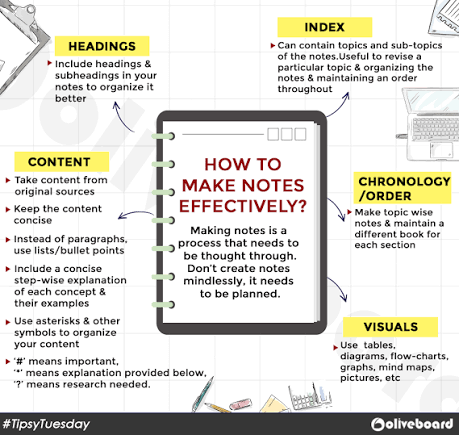
The most effective way to make study notes is to follow a repeatable process. Start with your syllabus, understand the material, identify important information, and organize it into a format that supports revision.
Step 1: Understand Your Syllabus and Exam Requirements
Before writing notes, review your syllabus, chapter objectives, and exam instructions.
Your syllabus tells you which topics you need to cover. Past papers, sample questions, and teacher guidance may also help you understand how topics are tested.
Create a checklist of chapters and divide them into manageable sections.
For example:
- Chapter 1: Basic definitions and concepts.
- Chapter 2: Important processes and diagrams.
- Chapter 3: Formulas and numerical problems.
- Chapter 4: Comparisons and long-answer questions.
Do not assume that a topic is unimportant simply because it appears difficult or lengthy. Follow the official syllabus and available exam guidance.
Step 2: Read the Material Before Writing
Read a short section of your textbook or lecture notes before summarizing it.
Try to understand the main idea, supporting details, and relationship between concepts. If a term is unfamiliar, look up its meaning using a reliable learning resource.
After reading, ask yourself:
- What is the main idea?
- Which facts are essential?
- What might I need to explain in an exam?
- Is there a formula, process, example, or diagram worth remembering?
Answering these questions helps you separate essential information from unnecessary detail.
Step 3: Write in Your Own Words
One of the most useful study note-taking tips is to explain concepts in simple language.
Avoid copying complete paragraphs directly from textbooks unless you need an exact quotation, definition, or formula. Instead, understand the meaning and rewrite it accurately.
For example:
Textbook-style explanation: Evaporation is the process through which a liquid changes into a gaseous state from its surface.
Study note: Evaporation occurs when liquid changes into vapor from its surface.
The second version is shorter but preserves the main idea.
However, do not simplify technical definitions so much that you change their meaning. Keep important terminology accurate, especially in science, mathematics, medicine, and other technical subjects.
Step 4: Identify the Most Important Information
Good exam notes focus on information that supports learning objectives and helps answer questions.
Highlight or record:
- Key definitions.
- Main arguments and explanations.
- Important dates and events.
- Mathematical formulas and units.
- Steps in a process.
- Advantages and disadvantages.
- Similarities and differences.
- Examples that clarify difficult ideas.
Use headings to separate major concepts from supporting details.
Avoid highlighting entire pages. If everything is marked as important, it becomes harder to identify what deserves your attention during revision.
Step 5: Organize Notes with Clear Headings
Use a consistent heading structure for every subject.
For example:
Chapter: The Water Cycle
Definition: The continuous movement of water between Earth’s surface and the atmosphere.
Main stages:
- Evaporation: Water changes into vapor.
- Condensation: Water vapor cools and forms droplets.
- Precipitation: Water falls as rain, snow, or another form of precipitation.
- Collection: Water gathers in rivers, lakes, oceans, and other locations.
Important question: Explain the main stages of the water cycle.
Revision reminder: Practice drawing and labeling the water cycle diagram.
This format makes the notes easy to scan and helps you identify the information you need.
Step 6: Choose the Right Note-Taking Method
Different subjects require different note formats. Choose a method that matches the information you are studying rather than forcing every topic into the same structure.
The Outline Method
The outline method organizes information using headings, subheadings, and bullet points.
Example:
- Main topic
- First concept
- Second concept
- Supporting detail
- Example
This method works well for theory-based subjects, textbook chapters, and lecture summaries.
The Cornell Note-Taking Method
The Cornell method divides a page into three main sections:
- Notes: The largest area for explanations and examples.
- Cues: A narrow area for keywords and questions.
- Summary: A short section at the bottom describing the main ideas.
After completing your notes, use the cue column to test your memory. Cover the main notes and try to answer the questions.
This method is especially useful for lectures and topics that require explanation.
The Mind Map Method
A mind map places the main topic in the center and connects it to related ideas using branches.
For example, a mind map about environmental pollution might include air pollution, water pollution, causes, effects, and prevention.
Mind maps are useful for understanding relationships, reviewing broad topics, and organizing connected ideas. They may be less suitable for detailed mathematical working or subjects that require precise written explanations.
The Chart Method
The chart method arranges information into rows and columns.
| Topic | Definition | Key Features |
|---|---|---|
| Evaporation | Liquid changes into vapor at its surface | Can occur below boiling point |
| Condensation | Vapor changes into liquid | Often occurs as vapor cools |
| Precipitation | Water falls from the atmosphere | Includes rain and snow |
Charts work well for comparisons, classifications, historical timelines, and vocabulary.
The Question-and-Answer Method
Turn each important topic into a question and write a concise answer beneath it.
Example:
Question: What is photosynthesis?
Answer: Photosynthesis is the process by which plants use light energy to make sugars from carbon dioxide and water, releasing oxygen in the process.
This format is especially helpful when preparing for short-answer questions, definitions, and self-testing.
Step 7: Add Diagrams, Examples, and Formulas
Some information is easier to understand visually than through long paragraphs.
Use diagrams for scientific processes, labeled illustrations for anatomy, timelines for historical events, and worked examples for mathematics.
For formulas, include three things:
- The formula itself.
- The meaning of each variable.
- One example showing how to apply it.
For example, the formula for speed is:
Speed = Distance ÷ Time
If a student travels 100 meters in 20 seconds:
Speed = 100 ÷ 20 = 5 meters per second.
Showing the working helps you understand how to use the formula rather than merely memorizing it.
Step 8: Highlight Key Information Carefully
Colors can help you distinguish different types of information, but too many colors may make your notes distracting.
Choose a simple system and use it consistently.
For example:
- One color for definitions.
- Another color for formulas.
- A third color for important questions.
- A symbol or underline for topics that need more revision.
You do not need expensive stationery or elaborate designs. Clear handwriting, readable spacing, and logical organization are more important than decoration.
Step 9: Review and Correct Your Notes
After completing a chapter, compare your notes with the textbook, lecture materials, and syllabus.
Check that:
- Definitions are accurate.
- Formulas and units are correct.
- Important concepts have not been omitted.
- Diagrams are labeled properly.
- Examples match the explanations.
- The notes are understandable without rereading the entire chapter.
Correct mistakes before relying on the notes for exam preparation.
Step 10: Turn Your Notes into Revision Questions
Do not stop after writing the notes. Use them to test your knowledge.
Create questions from headings, cover the answers, and try to explain each concept from memory. Then check your response and correct anything you missed.
You can also solve textbook exercises, practice past-paper questions, and write timed answers.
This final step turns note-making into an active study process rather than a copying exercise.
How to Make Study Notes for Different Subjects
The best study notes depend on the subject, the type of examination, and the way information needs to be used.
Science Subjects
For biology, chemistry, and physics, include definitions, diagrams, formulas, processes, and worked examples.
For biology, use labeled diagrams and process summaries. For chemistry, organize reactions, conditions, and equations. For physics, record formulas, units, and example problems.
Always verify scientific information against your course materials.
Mathematics
Mathematics notes should focus on formulas, methods, worked examples, and common errors.
Instead of writing lengthy theoretical explanations for every problem, show the steps needed to solve each type of question.
Include at least one example and then solve similar problems independently.
Remember that reading a worked solution is not the same as being able to solve a problem without help.
History and Social Studies
Use timelines, cause-and-effect charts, important dates, key people, and short explanations of events.
Organize long-answer topics into an introduction, main points, supporting evidence, and conclusion.
For comparison questions, a table can help you identify similarities and differences quickly.
English and Literature
Record grammar rules, vocabulary, literary terms, character descriptions, themes, and important plot developments.
For essays, create outlines containing the main argument and supporting points. If your exam requires quotations, record accurate quotations and their context from the assigned text.
Practice writing answers in your own words instead of relying entirely on memorized paragraphs.
Computer Science and Technical Subjects
Include key terminology, algorithms, diagrams, syntax examples, and step-by-step explanations.
For programming, record what a code example does, why it works, and common errors. Test the code yourself when possible.
For technical subjects, prioritize understanding and application over memorizing definitions alone.
Digital Study Notes vs. Handwritten Notes
Both handwritten and digital notes can be useful. The right option depends on your subject, available devices, typing comfort, and revision habits.
| Feature | Handwritten Notes | Digital Notes |
|---|---|---|
| Organization | Requires folders or notebooks | Can use folders, tags, and search |
| Editing | Corrections may take more space | Usually easy to edit and rearrange |
| Diagrams | Useful for quick sketches | Useful with drawing or diagram tools |
| Accessibility | Available in the notebook | May sync across supported devices |
| Distractions | Usually fewer device-related distractions | Notifications and other apps can interrupt |
| Best use | Quick summaries and calculations | Searchable notes and large collections |
Research on note-taking suggests that the way students process information matters, not simply whether they use a pen or keyboard. Handwriting may encourage summarization in some situations, while digital notes can offer convenient organization and access.
Neither format guarantees better exam results. Understanding the material, practicing retrieval, and reviewing consistently remain essential.
A practical approach is to use whichever format allows you to create accurate, readable notes and revise them regularly.
How to Revise from Study Notes Before Exams
Revision should involve recalling information, checking understanding, and practicing exam-style questions. Simply reading notes repeatedly may create a feeling of familiarity without confirming that you can remember the material independently.
Use Active Recall
Read a heading, close your notebook, and explain the topic from memory. Write down the main points or answer a question without looking at the solution.
Check your answer afterward and revisit missing information.
Use Spaced Revision
Review material across multiple study sessions rather than leaving all revision until the final day.
For example, you might review a topic on the day you learn it, revisit it the following day, and test yourself again several days later. Adjust the intervals according to how well you remember the information and how much time remains before your exam.
There is no single revision schedule that works equally well for every student or subject.
Practice Past Papers
Past papers and sample questions help you understand the question format and apply knowledge under exam conditions.
After completing a question, compare your answer with the marking scheme or reliable model answer when available.
Record the mistakes you make and add short reminders to your notes.
Create a One-Page Summary
Once you understand a chapter, try summarizing its most important points on one page.
Include the main definitions, formulas, relationships, and questions you often get wrong. This page should support revision, not replace the detailed notes needed to understand the subject.
Common Mistakes to Avoid When Making Study Notes
Students sometimes spend too much time producing attractive notes and too little time learning from them.
Avoid these common mistakes:
Copying Everything from the Textbook
Copying large amounts of information makes notes longer without necessarily improving understanding.
Better approach: Summarize the main ideas, preserve essential details, and use examples where necessary.
Making Notes Too Short
Overly brief notes may omit the explanations needed to understand a concept later.
Better approach: Include enough context to explain the idea without reopening the textbook every time.
Decorating Instead of Studying
Colorful headings and neat handwriting can improve readability, but excessive decoration consumes time.
Better approach: Set a time limit for note-making and spend the remaining study time on recall and practice.
Ignoring Difficult Topics
Avoiding confusing chapters may leave important gaps in your preparation.
Better approach: Mark difficult concepts, seek clarification, and revisit them until you can explain the main ideas accurately.
Revising Only by Reading
Reading the same page repeatedly does not show whether you can recall the information independently.
Better approach: Use practice questions, flashcards, blank-page summaries, and timed answers.
Leaving All Revision Until the Last Day
Last-minute revision can make it difficult to identify and correct knowledge gaps.
Better approach: Make a manageable revision plan and revisit important topics regularly.
Practical Study Notes Example
Suppose you are preparing for a school science examination and need to study the topic of evaporation.
You could organize your notes like this:
Topic: Evaporation
Definition: The change of a liquid into vapor from its surface.
Factors affecting evaporation:
- Temperature: Higher temperatures generally increase the rate of evaporation.
- Surface area: A larger exposed surface generally allows faster evaporation.
- Air movement: Moving air can carry vapor away from the surface.
- Humidity: Lower humidity generally favors faster evaporation.
Example: Wet clothes usually dry faster in warm, windy conditions than in cool, humid conditions, assuming other conditions are comparable.
Possible exam questions:
- Define evaporation.
- Name three factors affecting evaporation.
- Explain why clothes dry faster on a windy day.
- Differentiate evaporation from boiling.
Self-test: Close your notes and explain the definition, factors, and example without looking.
This structure gives you the key information, a practical example, and questions for revision in one place.
Frequently Asked Questions
1. How do I make study notes for exams quickly?
Start by reviewing the syllabus and selecting one topic at a time. Read the relevant material, identify the main concepts, and summarize them using headings, bullet points, formulas, and examples. Avoid copying entire paragraphs or spending too much time decorating. Finish by creating a few questions that you can answer from memory.
2. Should I write study notes by hand or on a laptop?
Both handwritten and digital notes can support effective learning. Handwritten notes are convenient for diagrams and calculations, while digital notes are easy to edit, search, and organize. Choose the format that helps you understand the material and revise consistently. Regardless of the format, test yourself regularly instead of relying only on rereading.
3. How long should study notes be?
Study notes should be long enough to explain the important concepts but short enough to review efficiently. A simple topic may need only a few bullet points, while a complex chapter may require several pages, diagrams, and worked examples. Focus on accuracy, understanding, and relevance rather than trying to meet a fixed page count.
4. What is the best note-taking method for exam preparation?
There is no single best method for every subject. The outline method works well for organizing theory, Cornell notes support question-based revision, mind maps show relationships, and charts help compare information. Mathematics often requires worked examples, while science subjects may benefit from diagrams and formulas. Choose the method that matches the material and your exam requirements.
5. How can I remember information from my study notes for longer?
Use active recall and spaced revision. Try answering questions without looking at your notes, check your mistakes, and review difficult topics again after increasing intervals. Practice exam-style questions to apply what you know. Sleep, breaks, and a realistic study schedule can also support learning, while repeated passive reading alone may not reveal gaps in your memory.
Conclusion
Learning how to make study notes for exams can help you organize information, understand difficult topics, and prepare for examinations with greater confidence. The most useful notes are accurate, concise, easy to navigate, and designed around the material you actually need to learn.
Start by checking your syllabus, reading one topic carefully, and summarizing its main ideas in your own words. Add formulas, diagrams, examples, and practice questions wherever they help. Then use active recall, spaced revision, and past papers to check your understanding.
Your next step: Choose one chapter today, create a short set of organized study notes, and test yourself without looking at the answers. Improve your notes based on what you remember and what you still need to learn.