
Introduction
Spaced repetition study techniques help students remember information for longer by reviewing it at carefully planned intervals instead of studying everything in one sitting. This evidence-informed learning method can improve long-term retention, make revision more efficient, and help students prepare for exams with less last-minute pressure.
Whether you are studying for school exams, university assessments, competitive tests, or professional certifications, spaced repetition can help you manage difficult subjects and retain important concepts. This guide explains how spaced repetition works, how to create a practical study schedule, which tools to use, and which common mistakes to avoid.
What Are Spaced Repetition Study Techniques?
Spaced repetition study techniques are learning methods that involve reviewing information multiple times with increasing intervals between sessions. Rather than repeating the same material continuously, students revisit it after progressively longer periods to strengthen long-term memory.
For example, if you learn a biology concept on Monday, you might review it on Tuesday, again on Thursday, then the following week. The exact schedule depends on how difficult the material is and how well you remember it.
The purpose is to make each review meaningful. When you attempt to recall information after some time has passed, you practise retrieving it from memory rather than simply recognizing words on a page.
How Does Spaced Repetition Work?
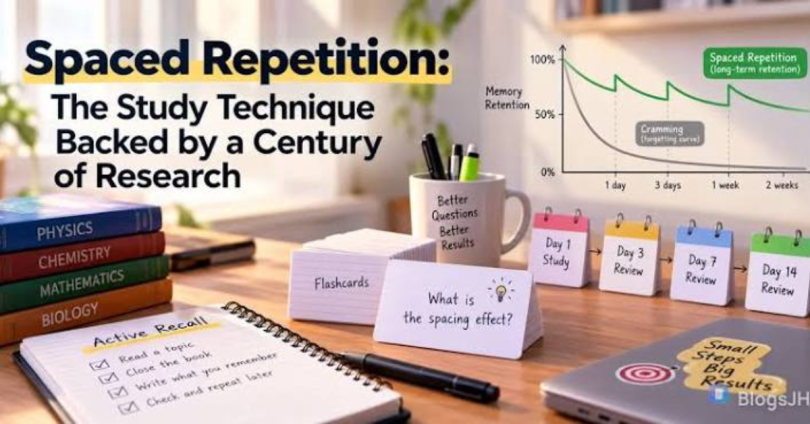
Spaced repetition works by combining two useful learning principles: the spacing effect and active recall.
The spacing effect means that learning sessions distributed over time can support long-term retention better than concentrating the same practice into one session.
Active recall involves retrieving information from memory without immediately looking at the answer. Examples include answering practice questions, explaining a concept from memory, or using flashcards.
When students combine these methods, they repeatedly retrieve information at intervals, identify weak areas, and revisit concepts before they become too difficult to remember.
What Is the Difference Between Spaced Repetition and Cramming?
Cramming involves studying a large amount of information in a short period, often immediately before an exam. Spaced repetition distributes learning across several sessions.
Cramming may help with short-term preparation, but it often leaves less opportunity to revisit information after the initial learning session. Spaced repetition encourages students to strengthen their understanding over time.
For example, studying 30 vocabulary words for two hours on Sunday is different from learning the words on Sunday and reviewing them briefly throughout the following week.
The second approach creates several opportunities to retrieve the information, making it more suitable for long-term learning.
Why Are Spaced Repetition Study Techniques Effective?
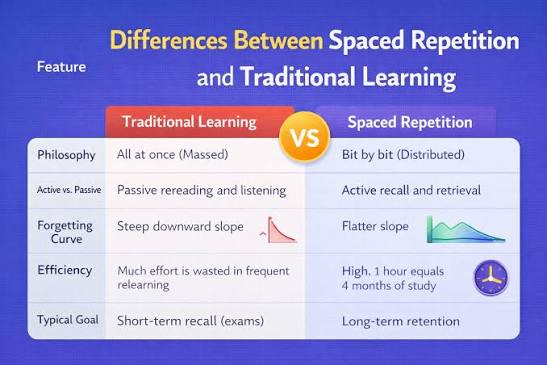
Spaced repetition is useful because memory changes over time. Information that seems familiar immediately after studying may become difficult to recall several days later.
Reviewing material at intervals gives students additional opportunities to retrieve and reinforce what they have learned. The method also helps them identify which concepts need more attention.
1. They Support Long-Term Memory
One of the main benefits of spaced repetition is improved retention over time.
Instead of repeatedly reading the same chapter during one evening, students return to the important ideas across several days or weeks. Each review provides another opportunity to recall the information and strengthen learning.
This approach is especially helpful when information must be remembered for future exams, cumulative assessments, or practical applications.
2. They Make Study Sessions More Focused
Spaced repetition encourages students to spend time on material that needs attention rather than treating every topic as equally difficult.
For example, if you can easily remember ten vocabulary words but repeatedly forget five others, you can review the five difficult words more frequently.
This makes study sessions more targeted and reduces unnecessary repetition.
3. They Help Reduce Last-Minute Cramming
A planned revision schedule spreads preparation across the available time.
Students who begin early can revisit important concepts gradually instead of trying to relearn an entire subject the night before an exam.
Although spaced repetition cannot eliminate all exam stress, it can make preparation more organized and predictable.
4. They Encourage Active Learning
Passive activities, such as highlighting paragraphs or rereading notes, can make information feel familiar without confirming that you can recall it independently.
Spaced repetition works especially well when each review requires you to answer questions, explain ideas, or solve problems without looking at the solution first.
This helps reveal gaps in understanding before an important assessment.
5. They Can Improve Study Efficiency
Spaced repetition allows students to allocate their attention according to their memory performance.
Easy information may require less frequent review, while difficult concepts may need shorter intervals and additional practice.
However, the method does not guarantee that every subject will take less time to learn. Complex topics may still require substantial explanation, problem-solving, and practice.
How to Use Spaced Repetition Study Techniques Step by Step
You do not need expensive software or a complicated timetable to start using spaced repetition. A notebook, flashcards, or a digital reminder system can be enough.
Follow these steps to build a practical routine.
Step 1: Divide Your Subject into Small Topics
Start by breaking your subject into manageable sections.
For example, a biology course might include:
- Cell structure
- Photosynthesis
- Cellular respiration
- Genetics
- Human body systems
Small topics are easier to review and test individually. Avoid creating flashcards that contain an entire chapter or several unrelated ideas.
Step 2: Learn the Material Before Reviewing It
Spaced repetition is not a replacement for understanding.
Read your textbook, attend the lesson, watch a relevant educational explanation, or study your class notes. Make sure you understand the basic concept before creating review questions.
For complicated subjects, use examples and diagrams to clarify the material.
Once you understand a topic, identify the key facts, definitions, relationships, and procedures that you need to remember.
Step 3: Create Useful Flashcards or Questions
Create prompts that require you to retrieve a specific piece of information.
For example:
Question: What is photosynthesis?
Answer: Photosynthesis is the process by which plants, algae, and certain bacteria use light energy to convert carbon dioxide and water into energy-rich organic compounds. In oxygen-producing photosynthesis, oxygen is also released.
You can also use questions that test relationships rather than isolated facts.
Question: Why do plants need light for photosynthesis?
Answer: Light supplies the energy that drives the reactions involved in converting carbon dioxide and water into organic compounds.
Keep each flashcard focused on one main idea. For difficult concepts, create several connected questions rather than one card with an excessively long answer.
Step 4: Choose Your Review Intervals
Begin with a manageable schedule and adjust it according to your performance.
A possible starting schedule is:
| Review session | Suggested timing |
|---|---|
| Initial learning | Day 1 |
| First review | Day 2 |
| Second review | Day 4 |
| Third review | Day 7 |
| Fourth review | Day 14 |
| Fifth review | Day 30 |
These intervals are examples, not a scientifically optimal schedule for every learner or subject. You may need shorter intervals for difficult material and longer intervals for information you consistently recall correctly.
The key is to revisit information over time rather than relying on one long study session.
Step 5: Test Yourself Before Checking the Answer
During each review, attempt to answer the question before revealing the answer.
For physical flashcards, read the question on the front and say or write the answer from memory. For digital flashcards, hide the answer until you have made a genuine attempt.
Then compare your response with the correct explanation.
If your answer is incomplete or incorrect, study the missing information and schedule another review sooner.
If you recall it accurately and confidently, you can generally increase the interval before the next review.
Step 6: Track Your Progress
Keep a simple record of which topics you remember and which ones require more practice.
You can use three categories:
- Easy: You recalled the answer accurately and confidently.
- Needs practice: You remembered the main idea but missed important details.
- Difficult: You could not recall the answer or misunderstood the concept.
Review difficult items more frequently. Revisit partially remembered material after a shorter interval, and gradually extend intervals for information you know well.
Step 7: Combine Spaced Repetition with Practice
Some subjects require more than memorizing facts.
Mathematics, physics, chemistry, programming, and essay-based subjects involve applying concepts to unfamiliar problems.
For these subjects, alternate flashcard reviews with practice questions, worked examples, written explanations, and timed exercises.
For example, a mathematics student might use flashcards to remember formulas but solve several problems to learn when and how to apply them.
This combination helps connect factual knowledge with practical understanding.
Best Spaced Repetition Study Techniques for Students
Different techniques serve different learning needs. You can select one or combine several depending on your subject, available time, and learning goals.
1. Flashcard-Based Spaced Repetition
Flashcards are among the most practical tools for spaced repetition because they make testing yourself simple.
Write a question on one side and its answer on the other. Review the cards regularly and place difficult cards in a more frequent review group.
Flashcards are especially useful for:
- Vocabulary and language learning
- Scientific definitions
- Historical dates and events
- Mathematical formulas
- Medical terminology
- Important facts and concepts
Avoid memorizing isolated details without understanding their meaning. Add examples or context when necessary.
2. Active Recall with Spaced Intervals
Active recall means retrieving information without looking at your notes.
After learning a topic, close your book and write down everything you can remember. Then compare your response with the source material and identify missing details.
Repeat the process over several days.
This technique works well for chapter summaries, essay preparation, scientific explanations, and conceptual subjects.
3. The Leitner System
The Leitner system is a flashcard organization method that uses boxes or groups to determine review frequency.
A simple version uses three groups:
- Box 1: Difficult cards reviewed frequently.
- Box 2: Cards remembered correctly and reviewed less frequently.
- Box 3: Well-known cards reviewed at longer intervals.
When you answer a card correctly, move it to the next group. When you answer incorrectly, move it back to the first group.
You can assign daily, every-few-days, and weekly reviews to the groups. The exact schedule is flexible.
The main advantage is that difficult cards receive more attention while familiar cards require less frequent review.
4. Spaced Practice for Mathematics
Mathematics requires understanding procedures and applying them correctly.
To use spaced repetition in mathematics, identify the formula or problem-solving skill you want to remember. Review the underlying concept, then solve problems that use it.
For example, after learning the quadratic formula, you might solve a simple equation on the first day, complete another problem two days later, and attempt a more challenging question the following week.
Do not rely only on remembering the formula. Practise recognizing when it applies and checking your calculations.
5. Spaced Repetition for Language Learning
Language learners can use spaced repetition to remember vocabulary, grammar patterns, phrases, and verb forms.
A useful vocabulary card might contain a word on the front and its meaning, an example sentence, and a pronunciation guide on the back.
For stronger learning, alternate recognition exercises with production exercises. Recognizing a word when you see it is different from recalling it when speaking or writing.
Regularly using new vocabulary in sentences helps connect memorized information with real communication.
6. The Blurting Method with Spaced Repetition
The blurting method involves writing everything you remember about a topic without checking your notes.
After completing your explanation, compare it with your textbook or class notes. Mark missing facts, incorrect statements, and concepts you could not explain clearly.
Revisit the topic after an interval and repeat the process.
This method is particularly helpful for broad topics that cannot easily be reduced to individual flashcards. It is most useful when followed by careful checking, because unverified recall can include mistakes.
How to Create a Spaced Repetition Study Schedule
A good study schedule should be realistic enough to follow consistently. It should include new learning, scheduled reviews, and time for difficult material.
Here is an example of how a student could organize one week of revision.
| Day | Study activity |
|---|---|
| Monday | Learn Topic A and create flashcards |
| Tuesday | Review Topic A and learn Topic B |
| Wednesday | Review Topic B and practise difficult questions |
| Thursday | Review Topic A and learn Topic C |
| Friday | Review Topics B and C |
| Saturday | Complete a mixed quiz covering all three topics |
| Sunday | Correct mistakes and plan the next week’s reviews |
This is an illustrative schedule. Your actual workload will depend on the number of subjects, the difficulty of the material, and your examination date.
How Long Should Each Study Session Last?
There is no single session length that works for every student.
A short review of familiar flashcards may take only a few minutes, while learning a difficult scientific concept may require a longer session.
As a starting point, try a 20- to 30-minute focused study period, followed by a short break when needed. Use the time to review scheduled cards, answer questions, and correct mistakes.
If your review queue becomes too large, reduce the number of new cards you introduce and focus on existing material.
How Often Should You Review Difficult Topics?
Review difficult topics more frequently than information you recall easily.
If you repeatedly forget a concept, shorten the next interval and examine why you are struggling. You may need a clearer explanation, a worked example, or a better-designed flashcard.
If you consistently answer correctly, gradually extend the interval.
The aim is not to follow a rigid timetable regardless of performance. It is to adapt the schedule to what you can actually remember.
Best Spaced Repetition Apps and Tools
Digital tools can automate review scheduling and help students organize large collections of flashcards. However, a digital application is not essential; paper cards and a calendar can also work.
Anki
Anki is a flashcard application known for its customizable review scheduling and support for large collections of cards.
It can be useful for students who need to remember substantial amounts of information over long periods. Users can create their own cards and organize material by subject.
Its many settings and features may require some time to learn, so beginners can start with a small deck.
Quizlet
Quizlet offers digital study sets and learning activities, depending on the features available under the user’s plan and account.
It can be useful for organizing vocabulary, definitions, and course material. Students should check which review and scheduling features are currently available rather than assuming every feature is included in the free version.
RemNote
RemNote combines note-taking with flashcards and spaced repetition features.
It may suit students who prefer connecting their notes and review questions in one workspace. As with any application, its usefulness depends on whether the workflow fits your learning habits.
Physical Flashcards and a Notebook
Paper flashcards are a practical option for students who do not want to rely on a phone, internet connection, or subscription.
Write questions on one side and answers on the other. Use labeled envelopes, boxes, or notebook sections to organize cards by review frequency.
The most important factor is consistent retrieval practice and appropriate spacing, not the specific tool you choose.
Spaced Repetition vs. Other Study Methods
Spaced repetition works best when you understand how it differs from other learning approaches.
| Study method | Main purpose | Best use |
|---|---|---|
| Spaced repetition | Reviews information at intervals | Long-term retention |
| Active recall | Retrieves information from memory | Testing understanding and memory |
| Practice testing | Uses quizzes or exam-style questions | Identifying knowledge gaps |
| Interleaving | Mixes different problem types or topics | Learning to distinguish and apply methods |
| Summarization | Condenses information into key points | Organizing and understanding material |
| Cramming | Concentrates study into a short period | Last-minute review when time is limited |
These methods are not mutually exclusive. For example, you can use active recall during every spaced repetition session and include mixed practice questions to improve your ability to apply knowledge.
Summarization can also help you understand a topic before converting its most important ideas into review questions.
Common Spaced Repetition Mistakes to Avoid
Spaced repetition is straightforward, but certain habits can reduce its effectiveness.
1. Reviewing Without Testing Yourself
Reading the answer repeatedly may create a sense of familiarity without proving that you can retrieve it independently.
How to avoid it: Attempt the answer before looking at your notes or revealing the back of a flashcard.
2. Creating Flashcards with Too Much Information
Cards containing several paragraphs or multiple unrelated questions are difficult to review accurately.
How to avoid it: Focus each card on one main question or relationship. Break complex topics into smaller cards and link them through examples when necessary.
3. Using the Same Interval for Every Topic
A fixed schedule may not suit every subject or every memory.
How to avoid it: Review difficult material sooner and extend intervals when you recall information consistently. Treat suggested schedules as starting points, not strict rules.
4. Ignoring Mistakes
Moving past incorrect answers without understanding them can allow misunderstandings to persist.
How to avoid it: Check the correct answer, identify why your response was wrong, and review the concept again. For calculation-based subjects, work through the reasoning rather than memorizing the final answer.
5. Creating Too Many New Cards
Adding large numbers of flashcards every day can create an overwhelming review queue.
How to avoid it: Start with a manageable number of new cards. Increase your workload only when you can complete scheduled reviews consistently.
6. Memorizing Without Understanding
A student may memorize a definition but fail to explain it or apply it to a new situation.
How to avoid it: Combine flashcards with explanations in your own words, examples, diagrams, and practical exercises.
7. Skipping Sleep and Breaks
Studying for long hours while neglecting sleep can undermine attention, learning, and recall.
How to avoid it: Maintain a realistic schedule, take breaks when needed, and get sufficient sleep. Spaced repetition should support healthy study habits rather than encourage constant revision.
How to Make Spaced Repetition More Effective
You can improve your study routine by combining a few practical habits.
Use Clear Questions
Write prompts that have a clear purpose and an answer you can evaluate. Instead of asking, “What should I know about the French Revolution?” ask, “What major event began the French Revolution in 1789?”
Broad prompts can still be useful for essay preparation, but focused prompts make routine flashcard reviews easier to assess.
Mix Recognition with Recall
Some questions should ask you to recognize the correct answer, while others should require you to produce it without hints.
For example, use multiple-choice questions for initial practice and open-ended questions to check whether you can explain the concept independently.
Review Errors First
Begin a session by identifying cards or topics that were previously difficult. Address these before spending too much time on material you already know well.
This helps direct attention toward knowledge gaps.
Use Examples and Real Applications
For abstract concepts, create questions that require you to apply the information to a new example.
A student studying grammar might recall a rule and then write an original sentence demonstrating it. A physics student might remember a formula and solve a problem that uses it.
Application helps you move beyond memorization.
Keep the Routine Sustainable
A simple schedule that you follow consistently is usually more useful than a complicated system you abandon after a few days.
Choose a manageable daily review time, track your progress, and adjust the number of new topics according to your workload.
Frequently Asked Questions
1. What is the best spaced repetition schedule for students?
A useful starting schedule is to review material after one day, three days, one week, two weeks, and one month. However, these intervals are examples rather than a universal formula. Review difficult information sooner and extend intervals when you can recall it accurately. Your subject, learning goals, and exam date should guide adjustments.
2. How many times should I repeat information using spaced repetition?
There is no fixed number of reviews that guarantees long-term memory. Some information becomes familiar after a few successful retrievals, while difficult concepts may require many more sessions. Focus on whether you can recall and apply the information after increasing intervals, rather than counting repetitions alone.
3. Is spaced repetition better than rereading notes?
Spaced repetition combined with active recall is often more useful for long-term retention than relying on repeated rereading alone. Rereading can still help you understand unfamiliar or complicated material. A practical approach is to learn through reading and explanation first, then use spaced retrieval and practice questions to check what you remember.
4. Can I use spaced repetition without an app?
Yes. You can use paper flashcards, a notebook, a calendar, or a simple spreadsheet to organize reviews. Write questions and answers, record when each topic should be reviewed, and adjust the schedule according to your performance. Apps can automate scheduling, but they are optional rather than necessary.
5. Does spaced repetition work for every subject?
Spaced repetition is useful for remembering facts, vocabulary, definitions, formulas, and other information that must be retained over time. However, complex subjects also require understanding, problem-solving, writing, and practical application. Combine spaced reviews with worked examples, practice exams, explanations, and hands-on activities to develop deeper knowledge.
Conclusion
Spaced repetition study techniques provide a practical way to strengthen long-term memory, organize revision, and reduce dependence on last-minute cramming. By reviewing material at intervals, testing yourself before checking answers, and giving extra attention to difficult topics, you can make your study sessions more purposeful.
Start with one subject, divide it into manageable topics, and create a small set of useful flashcards. Review them the next day, revisit them over the following weeks, and adjust the intervals according to how well you remember the material.
The most effective study routine is one that combines consistent review with genuine understanding, active recall, sufficient rest, and regular practice. Begin with a simple schedule today and improve it as you discover what works best for you.