
introduction
Productivity tips for students can help you manage your time, improve concentration, complete assignments on schedule, and make studying less stressful. Whether you are in school, college, university, or preparing for important exams, the right study habits can help you use your available time more effectively.
Being a productive student does not mean studying all day without breaks. It means understanding your priorities, choosing effective learning methods, reducing distractions, and maintaining a healthy balance between academics and personal life. With a simple routine and consistent effort, you can make meaningful progress without feeling overwhelmed.
In this guide, you will learn practical ways to organize your study schedule, improve focus, remember information, overcome procrastination, and build habits that support long-term academic success.
1. Set Clear and Achievable Study Goals
Setting clear study goals is one of the most effective productivity tips for students because it gives every study session a specific purpose. Instead of sitting at your desk without a plan, decide exactly what you want to accomplish.
For example, rather than setting a vague goal such as studying mathematics, choose a measurable task like completing ten algebra problems or reviewing one chapter.
How to Set Better Academic Goals
Follow these steps to make your study goals more useful:
- Identify the subjects or assignments that need your attention.
- Break large tasks into smaller, manageable activities.
- Decide which tasks are most important.
- Set a realistic deadline for each activity.
- Review your progress at the end of the day.
For example, if you have a science exam next week, divide the syllabus into smaller sections and assign each section to a particular day. This makes preparation easier to manage.
Practical tip: Write down three important academic tasks every morning. Completing these tasks can give your day structure and help you stay focused.
2. Create a Realistic Study Schedule
A study schedule helps students decide when to study, which subjects to prioritize, and how much time to allocate to each task. A realistic timetable also reduces last-minute preparation.
You do not need to plan every minute of your day. Start with your fixed commitments, such as classes, meals, work, and sleep, and organize your study sessions around them.
Example of a Daily Study Timetable
| Time | Activity |
|---|---|
| 7:00 AM | Wake up and get ready |
| 8:00 AM–2:00 PM | Attend school or college |
| 2:00 PM–3:00 PM | Lunch and rest |
| 3:00 PM–4:00 PM | Review class notes |
| 4:00 PM–4:30 PM | Take a break |
| 4:30 PM–5:30 PM | Complete assignments |
| 5:30 PM–6:30 PM | Exercise or personal time |
| 7:00 PM–8:00 PM | Study a challenging subject |
| 8:00 PM–8:30 PM | Dinner |
| 8:30 PM–9:00 PM | Revise important concepts |
| 9:00 PM onward | Relax and prepare for sleep |
This is only an example. Adjust the timetable according to your classes, responsibilities, energy levels, and exam schedule.
Why a Study Schedule Works
A planned routine reduces the need to decide what to do next. It can also help you distribute learning across several days instead of trying to understand an entire subject in one sitting.
However, avoid creating a timetable that is too strict. Leave room for unexpected tasks and additional time for difficult subjects.
3. Use the Pomodoro Technique to Improve Focus
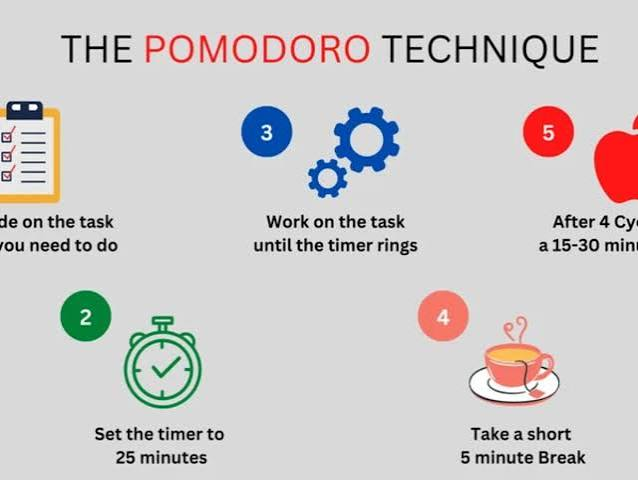
The Pomodoro Technique is a time-management method that divides work into focused intervals separated by short breaks. It can help students get started on difficult tasks and maintain attention.
A common version uses 25 minutes of focused work followed by a five-minute break. After four work intervals, you take a longer break.
How to Use the Pomodoro Technique
- Choose one specific study task.
- Set a timer for 25 minutes.
- Study without checking your phone or switching tasks.
- Take a five-minute break when the timer ends.
- Repeat the process and take a longer break after four intervals.
For example, you could use one interval to read a biology topic, another to create flashcards, and another to answer practice questions.
The technique is flexible. If 25 minutes feels too short or too long, adjust the interval to match your concentration and the task.
Important: A timer is a tool, not a rule. If you are deeply engaged in a complex problem, you can finish the current thought before taking your break.
4. Eliminate Distractions While Studying
Distractions interrupt concentration and make it harder to complete academic tasks efficiently. Common distractions include social media, messaging apps, television, background conversations, and unnecessary phone notifications.
Creating a study-friendly environment can make focused work easier.
Practical Ways to Reduce Distractions
- Put your phone on silent or enable Do Not Disturb.
- Keep unrelated browser tabs closed.
- Study in a quiet, organized location when possible.
- Tell family members or roommates when you need uninterrupted time.
- Keep only the books and materials required for your current task.
- Use website blockers if you frequently visit distracting websites.
You do not need an expensive desk or a perfectly quiet room to study effectively. A small, consistent study space can be enough.
What If You Need Your Phone for Studying?
Use your phone intentionally. Open the educational app, lecture, or document you need before starting, and avoid switching to unrelated apps.
If online distractions remain a problem, download reading materials in advance when possible and temporarily disconnect from the internet.
5. Prioritize Important Tasks First
Students often have several responsibilities at once, including homework, exam preparation, presentations, group projects, and extracurricular activities. Trying to complete everything simultaneously can lead to stress and unfinished work.
Prioritization helps you focus on the tasks that matter most.
Use the Important-versus-Urgent Method
Organize your tasks into four groups:
- Important and urgent: An assignment due tomorrow or an exam taking place soon.
- Important but not urgent: Preparing for an exam scheduled next month.
- Urgent but less important: A minor request that needs a quick response.
- Neither urgent nor important: Activities that can wait without causing a problem.
Start with tasks that have serious deadlines or contribute significantly to your academic goals. Schedule important long-term work before it becomes urgent.
For example, reviewing a difficult subject for 30 minutes each day may be more manageable than trying to learn the entire subject the night before an exam.
6. Break Large Assignments into Smaller Tasks
Large assignments can feel overwhelming because they require several steps. Breaking them into smaller tasks makes it easier to begin and track progress.
Suppose you need to write a 2,000-word research paper. Instead of treating the entire paper as one task, divide it into manageable stages.
A Simple Assignment Breakdown
- Understand the instructions and marking criteria.
- Choose a topic and define the main question.
- Research reliable sources.
- Prepare an outline.
- Write the first draft.
- Review the argument and supporting evidence.
- Check grammar, citations, and formatting.
- Submit the completed assignment before the deadline.
Each completed step brings you closer to finishing the assignment.
This approach also helps you identify problems early. If research takes longer than expected, you can adjust your schedule before the final deadline.
Practical tip: When you feel stuck, choose a task that takes only five to ten minutes. Opening the document, writing three headings, or reviewing one page can help you build momentum.
7. Use Active Recall to Remember More Information
Active recall is a learning technique in which you retrieve information from memory instead of simply rereading it. It helps you check what you understand and identify topics that require more practice.
For example, after studying a chapter about the human heart, close your book and explain how blood moves through the heart. Then check your explanation against your notes.
Effective Active Recall Methods
You can practice active recall by:
- Answering questions without looking at your notes.
- Using flashcards with questions on one side and answers on the other.
- Writing a summary from memory.
- Explaining a concept in your own words.
- Completing practice questions under exam conditions.
If you cannot remember an answer, review the relevant material and test yourself again.
Active recall is useful across many subjects, including science, history, mathematics, languages, and professional courses. For subjects that involve problem-solving, combine recall with practical exercises rather than memorizing formulas alone.
8. Review Lessons Using Spaced Repetition
Spaced repetition means reviewing information at intervals over time rather than attempting to learn everything in one session. It can support long-term retention and reduce the need for intensive last-minute revision.
The ideal review schedule depends on the subject, how difficult the material is, and how well you remember it.
Example of a Spaced Repetition Schedule
A simple starting schedule could look like this:
- Day 1: Learn the topic and test your understanding.
- Day 2: Review the main concepts.
- Day 4: Answer questions without checking your notes.
- Day 7: Complete a short practice test.
- Day 14: Review the parts you still find difficult.
These intervals are an example, not a universal formula. If you forget a concept quickly, review it sooner. If you can recall it confidently, you may be able to leave more time before the next review.
Combine Spaced Repetition with Active Recall
For the best use of study time, try to retrieve information from memory during each review session. Simply rereading familiar notes can create a sense of confidence without revealing what you can actually remember.
Use your mistakes to decide what to study next.
9. Take Regular Breaks and Protect Your Energy
Regular breaks can help students manage mental fatigue and maintain a sustainable study routine. Studying continuously for hours is not always productive, especially when concentration begins to decline.
A useful break should help you recharge rather than introduce another distraction that is difficult to stop.
What to Do During Study Breaks
Consider activities such as:
- Standing up and stretching.
- Walking around for a few minutes.
- Drinking water.
- Looking away from your screen.
- Having a light snack if you are hungry.
- Getting some fresh air.
Avoid spending every break scrolling through social media if it often causes you to lose track of time.
Sleep is equally important. Regularly sacrificing sleep to study can interfere with attention, memory, and learning. Students should aim for an age-appropriate amount of sleep and maintain a consistent sleep schedule where possible.
Remember: Productivity is not measured by how long you sit at your desk. It is better measured by meaningful progress, understanding, and sustainable habits.
10. Use Technology to Organize Your Studies
Digital tools can help students manage deadlines, organize notes, track assignments, and access learning materials. The key is choosing tools that solve a real problem rather than installing too many apps.
Useful Types of Student Productivity Tools
Digital calendars: Google Calendar and similar tools can help you schedule classes, exams, assignment deadlines, and revision sessions.
Task managers: Apps such as Todoist or Microsoft To Do can help you maintain a list of assignments and mark tasks as complete.
Digital notes: OneNote and similar note-taking tools can organize lecture notes, topic summaries, and research materials.
Flashcard tools: Apps such as Anki can support active recall and spaced repetition.
Focus timers: A simple timer can help you divide work into manageable intervals and remind you to take breaks.
Choose tools that suit your device, study habits, accessibility needs, and budget. You can also use a notebook and paper timetable if you prefer studying without screens.
Common Technology Mistakes
Avoid spending too much time customizing productivity apps, switching between several tools, or organizing notes instead of learning the material.
A basic system that you use consistently is usually more practical than a complicated system that requires constant maintenance.
11. Avoid Multitasking During Study Sessions
Multitasking may feel efficient, but frequently switching between demanding tasks can interrupt concentration and increase the time needed to complete work.
For example, alternating between solving mathematics problems, answering messages, and watching videos can make it harder to maintain your train of thought.
Practice Single-Tasking
Follow a simple process:
- Choose one subject or assignment.
- Decide what you want to finish.
- Close unrelated apps and documents.
- Work on the selected task until the planned interval ends.
- Record any unrelated thoughts or tasks for later.
Single-tasking is especially useful when learning complex concepts, writing essays, solving problems, or preparing for exams.
You can still manage multiple responsibilities throughout the day. The goal is to handle them one at a time instead of constantly switching between them.
12. Improve Your Notes and Study Materials
Well-organized notes make revision easier, but writing everything a teacher says is not always the most effective approach. Good notes identify key concepts, important examples, questions, and connections between ideas.
How to Take Better Study Notes
- Write the main idea of each section in your own words.
- Use headings to separate topics.
- Record important definitions, formulas, and examples.
- Highlight only essential information.
- Add questions that you can answer during revision.
- Summarize the topic after class while it is still familiar.
You can use bullet points, diagrams, mind maps, or tables depending on the subject.
For example, a history student might organize notes by event, cause, consequence, and date. A mathematics student might record a formula, the conditions for using it, and a worked example.
Do Not Confuse Attractive Notes with Effective Learning
Colorful notes and elaborate layouts can be enjoyable, but they do not guarantee understanding. Spend enough time testing your knowledge and solving questions instead of repeatedly rewriting material you already know.
13. Overcome Procrastination with Small Actions
Procrastination occurs when you delay a task even though you know the delay may create problems later. Students may procrastinate because a task feels difficult, boring, confusing, or stressful.
The solution is not always to force yourself to work harder. Sometimes, you need to make the first step easier.
Practical Ways to Stop Procrastinating
Use the five-minute start. Commit to working on a task for just five minutes. You can continue if you feel ready, or reassess after getting started.
Define the next action. Instead of writing “study chemistry,” write “review the first two pages of chemical bonding.”
Remove the biggest distraction. If your phone is the main problem, put it in another room during your study session.
Set a personal deadline. Choose a realistic completion time before the official deadline.
Reward progress. After completing a challenging task, take a short break or enjoy a planned activity.
Why Do Students Procrastinate?
Common causes include fear of failure, perfectionism, unclear instructions, low energy, and feeling overwhelmed by the amount of work.
If you do not understand an assignment, ask your teacher or classmates for clarification. If you are exhausted, address your need for rest rather than relying on an unrealistic schedule.
The objective is to create a manageable starting point and build consistency over time.
14. Maintain a Healthy Balance Between Study and Personal Life
Academic success matters, but students also need time for rest, relationships, movement, and enjoyable activities. A routine that ignores these needs can become difficult to maintain.
A balanced schedule supports more sustainable study habits and helps you manage demanding periods without making every day feel like an emergency.
Habits That Support Student Well-Being
- Maintain a regular sleep routine.
- Include physical activity in your week.
- Eat regular, balanced meals.
- Spend time with friends and family.
- Take breaks from screens.
- Keep some time available for hobbies and relaxation.
- Ask for help when academic pressure becomes difficult to manage.
You may need to adjust your routine during exam periods, but try not to make extreme changes that leave you exhausted.
If stress consistently interferes with sleep, daily activities, or your ability to study, consider speaking with a trusted adult, teacher, school counselor, or qualified health professional.
15. Track Your Progress and Improve Your Routine
Tracking progress helps you understand which study methods are useful and where you need to make changes. It also allows you to recognize small achievements that might otherwise go unnoticed.
You do not need a detailed spreadsheet. A simple daily checklist or weekly review can be enough.
A Simple Weekly Study Review
At the end of each week, ask yourself:
- Which assignments and study goals did I complete?
- Which subjects still need attention?
- What distracted me most often?
- Which study techniques helped me understand the material?
- Did I get enough rest?
- What is one improvement I can make next week?
Use your answers to adjust your schedule. If you consistently underestimate how long assignments take, allow more time. If you focus better in the morning, schedule difficult tasks during that period when practical.
Avoid judging your progress only by the number of hours studied. Consider the quality of your understanding, the tasks completed, and your ability to recall information without assistance.
Common Productivity Mistakes Students Should Avoid
Even students with good intentions can develop habits that make studying less effective. Recognizing these mistakes can help you build a more useful routine.
1. Creating an Unrealistic Timetable
Planning ten hours of study after a full day of classes may not be practical. Create a schedule that accounts for meals, rest, travel, and other responsibilities.
2. Studying Only Before Exams
Last-minute preparation leaves less time to identify misunderstandings and practice difficult topics. Review your lessons regularly and start preparing early.
3. Relying Only on Rereading
Rereading can help you become familiar with information, but it does not always show whether you can remember or apply it. Include practice questions and active recall.
4. Ignoring Sleep and Breaks
Cutting back on sleep to gain extra study hours can make concentration and learning more difficult. Protect your sleep and take reasonable breaks.
5. Comparing Your Routine with Other Students
Students have different schedules, learning needs, responsibilities, and energy levels. Use other people’s methods as ideas, not as standards you must copy.
6. Trying Too Many Productivity Techniques at Once
Changing your entire routine overnight can make it difficult to identify what works. Start with one or two habits, practice them consistently, and add more when they become manageable.
Frequently Asked Questions
1. What Are the Best Productivity Tips for Students?
The most useful productivity tips for students include setting clear goals, creating a realistic study schedule, reducing distractions, breaking assignments into smaller tasks, and reviewing lessons regularly. Active recall and spaced repetition can also improve learning. Start with a few techniques that address your biggest challenges, then adjust your routine based on your progress.
2. How Can Students Study More Effectively in Less Time?
Students can use study time more effectively by focusing on important topics, testing their knowledge with practice questions, and reviewing information at spaced intervals. Keep your phone away during focused sessions and avoid unnecessary multitasking. Before starting, decide what you want to learn or complete so that each session has a clear purpose.
3. How Can I Stop Procrastinating on Homework?
Begin by identifying the smallest useful action you can take. For example, open the assignment, read the instructions, and write down the first three steps. Work for five minutes to make starting less intimidating. Remove distractions, set a realistic deadline, and ask for clarification if you do not understand the task.
4. Is the Pomodoro Technique Good for Students?
The Pomodoro Technique can help students organize study sessions into manageable periods of focused work and short breaks. A common approach is 25 minutes of study followed by five minutes of rest. However, the method is not suitable for every task or person. Adjust the intervals to match your concentration, learning needs, and schedule.
5. How Can Students Stay Motivated to Study Every Day?
Students can maintain motivation by setting achievable goals, following a consistent routine, tracking small improvements, and connecting daily tasks with longer-term academic goals. Avoid relying on motivation alone because it naturally changes from day to day. When you feel unmotivated, begin with a small task and build momentum through consistent action.
Conclusion
Productivity tips for students are most effective when they become practical, repeatable habits rather than a long list of rules. Clear goals, a realistic timetable, focused study sessions, active recall, spaced repetition, and regular breaks can help you learn more effectively and manage academic responsibilities.
You do not need to change everything at once. Start by choosing three actions: plan your most important tasks, study without unnecessary distractions, and test your understanding after each lesson. Follow these habits for a week, review what works, and make adjustments as needed.
Remember that productive studying is about learning with purpose, not simply spending more hours at your desk. With consistent effort and a balanced routine, you can improve your study habits and make steady progress toward your academic goals.