

Time management tips for students can make studying more organized, reduce unnecessary stress, and help students balance schoolwork, exams, hobbies, and personal responsibilities. Effective time management is not about studying every hour of the day. It is about using available time wisely, identifying priorities, and creating a realistic routine that supports learning and well-being.
Whether you are a school student, college student, university student, or someone preparing for competitive exams, the right strategies can help you complete assignments on time and prepare for examinations more confidently.
In this guide, you will learn 15 practical time management strategies, how to create a productive study schedule, which mistakes to avoid, and how to build habits that make academic life easier.
What Is Time Management for Students?
Time management for students is the process of planning and organizing time to complete academic tasks, personal responsibilities, and recreational activities efficiently. It involves deciding what to do, when to do it, and how much time to allocate to each activity.
Good time management helps students avoid last-minute studying and gives them a clearer understanding of their daily responsibilities.
For example, a student who has a mathematics test, an English assignment, and a science chapter to revise can schedule a specific time for each task instead of attempting everything the night before an examination.
Effective student time management includes:
- Setting clear academic goals.
- Prioritizing important assignments.
- Creating a daily or weekly study timetable.
- Reducing distractions during study sessions.
- Taking regular breaks.
- Reviewing progress and adjusting plans when necessary.
The goal is to create a balanced routine that makes learning consistent rather than exhausting.
Why Is Time Management Important for Students?
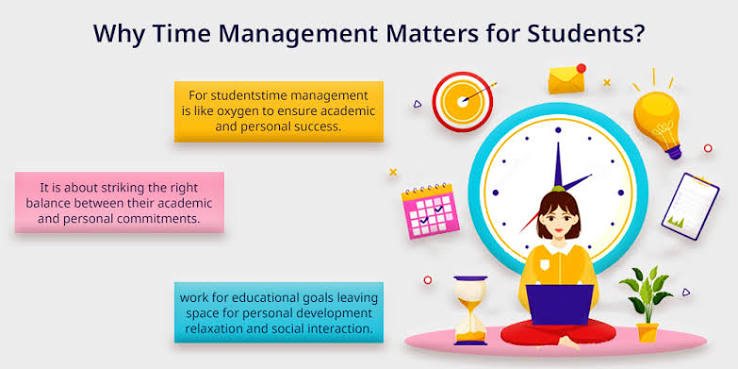
Time management is important because it helps students organize their workload, prepare for exams gradually, and make room for activities outside the classroom. A well-planned schedule can also make academic responsibilities feel more manageable.
Here are the main benefits of managing time effectively.
1. Reduces Academic Stress
When students know what they need to accomplish and when they will do it, their workload becomes easier to manage. Planning assignments ahead of deadlines also reduces the pressure associated with last-minute work.
2. Improves Study Consistency
Studying a subject regularly helps students revisit information before they forget it. Short, planned study sessions can be easier to maintain than occasional, lengthy sessions.
3. Helps Students Meet Deadlines
A schedule allows students to divide large assignments into smaller steps. This makes it easier to begin early, monitor progress, and finish work before the submission date.
4. Creates Time for Personal Activities
Students need time for sleep, exercise, family, friendships, and relaxation. Good time management helps them make room for these activities without unnecessarily neglecting academic responsibilities.
5. Encourages Independent Learning
Planning and completing tasks independently helps students develop responsibility, decision-making, and organizational skills that are useful beyond school or university.
15 Best Time Management Tips for Students
The most effective time management techniques are simple enough to follow consistently. Students do not need to use every strategy at once. Start with two or three methods and gradually add others as they become comfortable with the routine.
1. Set Clear and Achievable Study Goals
Setting goals gives your study sessions a clear purpose. Instead of sitting at your desk without knowing where to begin, decide exactly what you want to complete.
For example, replace a vague goal such as “study biology” with a specific task such as “review the cell structure chapter and answer ten practice questions.”
Try setting three types of goals:
- Daily goals: Complete a homework assignment or revise one topic.
- Weekly goals: Finish two chapters or prepare for a scheduled test.
- Long-term goals: Complete exam preparation or improve performance in a particular subject.
Make your goals realistic. Completing a few meaningful tasks is more useful than creating an ambitious schedule that you cannot maintain.
2. Create a Daily Study Timetable
A daily study timetable helps you decide when to study, complete assignments, attend classes, and take breaks. It also reduces the time spent deciding what to do next.
Start by listing your fixed commitments, such as classes, meals, travel, and family responsibilities. Then identify available study periods and assign a specific task to each one.
For example, a student might plan to revise mathematics after returning from school, complete an English assignment in the evening, and review science before bedtime.
Your timetable should include flexibility. Unexpected assignments, family activities, and difficult topics can change your plans, so leave some time for unfinished work.
3. Prioritize Tasks According to Importance
Not every academic task deserves the same amount of attention at the same time. Prioritizing helps you identify which tasks require immediate action and which can wait.
A simple way to organize your work is to divide tasks into four categories:
- Urgent and important: An assignment due tomorrow or preparation for an upcoming examination.
- Important but not urgent: Reviewing notes for a test scheduled next week.
- Urgent but less important: Minor administrative tasks with short deadlines.
- Neither urgent nor important: Activities that can be postponed without affecting your goals.
Begin with tasks that have significant consequences if delayed. However, do not ignore long-term preparation simply because another deadline is approaching.
4. Break Large Assignments into Smaller Tasks
Large projects can feel overwhelming when you think about completing everything at once. Breaking them into smaller steps makes it easier to begin and track your progress.
For example, if you need to write a research assignment, divide it into these stages:
- Understand the topic and requirements.
- Collect reliable information.
- Prepare an outline.
- Write the first draft.
- Review grammar, structure, and accuracy.
- Submit the final version.
Assign a realistic time slot to each stage. This approach helps you make progress even when you have limited time each day.
5. Use the Pomodoro Technique
The Pomodoro Technique is a time management method that divides work into focused intervals separated by short breaks. A common format is 25 minutes of focused work followed by a five-minute break.
After four work intervals, you can take a longer break, depending on your needs.
To use this method effectively:
- Choose one specific study task.
- Set a timer for 25 minutes.
- Put away unnecessary distractions.
- Work on the selected task until the timer ends.
- Take a short break before starting another interval.
This method can be helpful when you struggle to concentrate or find it difficult to begin studying.
However, 25 minutes is not a strict requirement. Some students prefer 40- or 50-minute sessions, especially when reading complex material or solving lengthy problems. Choose an interval that supports your concentration.
6. Eliminate Distractions While Studying
Distractions can interrupt concentration and make simple tasks take longer. Mobile notifications, social media, background conversations, and frequently switching between activities can interfere with focused study.
Create a study environment that makes concentration easier.
Practical steps include:
- Put your phone on silent or enable focus mode.
- Keep only the books and materials you need nearby.
- Close unrelated browser tabs.
- Choose a reasonably quiet study space.
- Inform family members when you need uninterrupted time, if possible.
You do not need a perfect study room. A clean desk, a clear task, and fewer interruptions can make a meaningful difference.
7. Avoid Multitasking
Multitasking may feel productive, but switching repeatedly between unrelated tasks can reduce efficiency and make it harder to concentrate on detailed work.
For example, reading a textbook while replying to messages forces your attention to move between two different activities.
Instead, use single-tasking. Finish a defined portion of one assignment before moving to another task.
If you remember something unrelated while studying, write it on a notepad and return to it later. This helps you preserve your focus without worrying about forgetting the thought.
8. Start with Your Most Challenging Task
Difficult tasks often require more concentration and mental effort. Completing one of them early in your available study period can prevent it from being postponed repeatedly.
For example, if algebra requires more effort than reading an English chapter, begin with algebra when you feel most alert.
However, this approach should remain flexible. If a short, simple task helps you overcome the difficulty of getting started, complete it first and then move to the harder task.
The main objective is to prevent important work from being delayed until the last minute.
9. Use Active Recall and Spaced Repetition
Managing study time is not only about deciding how long to study. It is also about choosing methods that help you learn efficiently.
Active recall means trying to remember information without immediately looking at your notes. You can use practice questions, flashcards, or short self-tests.
Spaced repetition means revisiting information across multiple study sessions rather than reviewing everything in one sitting.
For example, after studying a history chapter, close your book and write down the main events from memory. Review the topic again the next day, then revisit it after a few more days.
These methods can help you identify knowledge gaps and make revision more purposeful.
10. Set Realistic Deadlines for Every Task
A task without a deadline can remain unfinished because other activities continually take priority. Setting a target completion time encourages you to plan and monitor your progress.
For instance, you might decide to finish the first draft of an essay by Wednesday evening, even if the official submission deadline is Friday.
Whenever possible, set personal deadlines earlier than official deadlines. This gives you time to review your work and handle unexpected problems.
Avoid setting unrealistically short deadlines, as these may encourage rushed work and unnecessary stress.
11. Review Your Notes Regularly
Regular revision helps you keep track of what you understand and what still requires attention. It also reduces the need to relearn an entire subject immediately before an exam.
After each class, spend a few minutes identifying the main ideas and marking anything you did not understand.
At the end of the week, review important topics, answer practice questions, and revisit difficult concepts.
You can organize revision using a simple checklist:
- Topics I understand well.
- Topics I need to review.
- Questions I still cannot answer.
- Subjects that need additional practice.
This makes it easier to use your available study time where it is most needed.
12. Learn to Say No to Unnecessary Activities
Students often have competing demands from friends, entertainment, social media, and extracurricular activities. Participating in these activities is not inherently a problem, but saying yes to everything can leave too little time for essential responsibilities.
Before accepting an additional commitment, consider whether you have enough time to complete your existing work.
You do not need to avoid social activities completely. Instead, set reasonable limits and communicate your availability clearly.
A balanced schedule should include meaningful personal activities as well as academic work.
13. Get Enough Sleep and Take Breaks
Sleep and breaks are essential parts of a sustainable study routine. Staying awake late into the night may give you additional study hours temporarily, but repeated sleep deprivation can harm attention, memory, and learning.
Many teenagers need around eight to ten hours of sleep, while adults generally need at least seven hours per night. Individual needs can vary.
During study sessions, take short breaks to stretch, drink water, or move around. Longer breaks can be useful after demanding tasks.
Avoid treating every break as wasted time. Rest can help you return to your work with better readiness to concentrate.
14. Track Your Progress Every Week
A study plan becomes more useful when you regularly check whether it is working.
At the end of each week, spend ten to fifteen minutes reviewing your progress. Identify completed tasks, missed deadlines, and activities that took longer than expected.
Ask yourself:
- Which study methods worked well?
- Which subjects required more time?
- What distracted me most often?
- Did I leave enough time for sleep and relaxation?
- What should I change next week?
Use your answers to adjust your schedule. Effective time management is a skill that improves through practice, not a fixed routine that must remain unchanged.
15. Use Digital Tools to Organize Your Work
Digital tools can make it easier to track deadlines, organize notes, and remember upcoming exams. However, the best tool is the one you can use consistently without creating additional distractions.
Useful options include:
- Google Calendar: Schedule classes, assignments, exams, and study sessions.
- Google Tasks: Create simple task lists and reminders.
- Microsoft To Do: Organize schoolwork into manageable tasks.
- A digital or paper planner: Record deadlines and review daily priorities.
- A timer: Keep track of focused study sessions and breaks.
You do not need several apps to manage your time. Start with one calendar or planner and use it to keep all important deadlines in one place.
How to Make a Study Timetable That Actually Works
A realistic study timetable should fit your existing responsibilities, energy levels, and learning needs. The following steps can help you create one that is easier to maintain.
Step 1: List Your Daily Responsibilities
Write down your classes, travel time, meals, household responsibilities, extracurricular activities, and sleep schedule.
This gives you a clearer picture of how much time is genuinely available for independent study.
Step 2: Identify Your Academic Priorities
List upcoming exams, assignment deadlines, and subjects that need additional practice.
Give priority to tasks that are important or time-sensitive, while keeping regular revision in your schedule.
Step 3: Assign Study Blocks
Divide your available time into focused sessions. Assign a particular subject or task to each session instead of writing vague entries such as “study.”
Keep difficult tasks in periods when you usually feel more alert.
Step 4: Schedule Breaks and Free Time
Include short breaks, meals, exercise, and relaxation. A timetable that ignores your need for rest may become difficult to follow.
Step 5: Test and Adjust Your Schedule
Follow the timetable for several days and note what works. If a task regularly takes longer than expected, give it more time or divide it into smaller parts.
Your schedule should support your learning, not become another source of pressure.
Sample Daily Study Timetable for Students
The following example illustrates how a student with daytime classes might organize an ordinary weekday. Adjust the timings to match your school hours, commute, family responsibilities, and personal needs.
| Time | Activity |
|---|---|
| 6:30–7:30 AM | Wake up, get ready, and have breakfast |
| 8:00 AM–2:00 PM | Attend school or college |
| 2:00–3:00 PM | Lunch and relaxation |
| 3:00–4:00 PM | Homework and urgent assignments |
| 4:00–4:30 PM | Break or physical activity |
| 4:30–5:30 PM | Study a challenging subject |
| 5:30–6:30 PM | Personal time and family activities |
| 6:30–7:30 PM | Revision and practice questions |
| 7:30–8:30 PM | Dinner and relaxation |
| 8:30–9:00 PM | Review notes and plan tomorrow |
| 9:00 PM onward | Wind down and prepare for sleep |
This timetable is only an example, not a universal routine. Students with different school schedules, religious commitments, employment, or family responsibilities should adapt it to their circumstances.
Common Time Management Mistakes Students Should Avoid
Even students with good intentions can struggle when their study habits are unrealistic. Recognizing common mistakes makes it easier to build a better routine.
Creating an Overloaded Schedule
Planning every minute of the day leaves little room for unexpected tasks or rest. Start with your essential commitments and add study blocks gradually.
Procrastinating Until the Deadline
Delaying difficult work often increases pressure later. Make the first step small enough to begin, such as reading the assignment instructions or solving one practice question.
Studying Without Clear Goals
Sitting with books open does not guarantee meaningful progress. Define a specific outcome for each study session, such as completing a set of problems or summarizing a topic.
Ignoring Sleep and Breaks
Reducing sleep to create more study time can undermine concentration and learning. Protect your sleep schedule and include breaks in your plan.
Following Someone Else’s Routine Exactly
A timetable that works for another student may not suit your circumstances. Choose study periods based on your classes, responsibilities, energy levels, and academic goals.
Spending Too Much Time Planning
Planning is useful, but repeatedly redesigning a timetable can become another form of procrastination. Create a simple plan, begin working, and review it periodically.
Time Management Tips for Different Types of Students
Students have different schedules and challenges, so time management strategies should reflect their specific needs.
Time Management Tips for School Students
School students can benefit from establishing consistent homework and revision habits.
- Complete urgent homework before moving to less important activities.
- Review class notes regularly.
- Prepare school materials the night before.
- Limit entertainment during planned study periods.
- Ask teachers for clarification when a topic is difficult.
Time Management Tips for College and University Students
College and university students often need to manage independent study, multiple deadlines, projects, and examinations.
- Record assignment deadlines as soon as they are announced.
- Break research papers and projects into smaller stages.
- Start exam preparation well before the examination period.
- Use calendar reminders for classes, meetings, and submissions.
- Reserve time for group projects and unexpected changes.
Time Management Tips for Students Preparing for Exams
Exam preparation requires a clear revision strategy and regular practice.
- List all subjects and topics that must be covered.
- Identify weak areas using practice questions.
- Allocate more revision time to difficult or high-priority topics.
- Practise answering questions under timed conditions.
- Review mistakes instead of repeatedly studying only familiar material.
Time Management Tips for Students Who Work Part-Time
Students who work alongside their studies have fewer flexible hours, making realistic planning especially important.
- Use a weekly calendar to coordinate shifts and classes.
- Complete small revision tasks during genuinely available periods.
- Start major assignments early.
- Discuss schedule conflicts with the relevant people as soon as possible.
- Protect adequate sleep and avoid overcommitting.
The most effective plan is one that recognizes your actual limitations rather than assuming you have unlimited time.
Frequently Asked Questions
1. What Are the Best Time Management Tips for Students?
The best time management tips for students include setting clear goals, creating a realistic study timetable, prioritizing important assignments, breaking large tasks into smaller steps, and reducing distractions. Regular revision, sufficient sleep, and weekly progress reviews also help students maintain consistent study habits without overwhelming themselves.
2. How Can Students Manage Their Time Effectively Every Day?
Students can manage their time effectively by reviewing their responsibilities each morning, selecting three important tasks, and assigning specific study periods to them. They should schedule breaks, minimize phone distractions, and review their progress at the end of the day. Adjusting the plan when necessary helps keep it realistic.
3. What Is the Best Time Management Technique for Studying?
There is no single technique that works best for every student. The Pomodoro Technique can help students who struggle with concentration, while time blocking is useful for organizing a full day. Active recall and spaced repetition can improve revision sessions. Students should experiment with these methods and choose the ones that suit their needs.
4. How Can Students Stop Procrastinating on Their Studies?
Students can reduce procrastination by identifying the next small action instead of focusing on the entire assignment. For example, they can begin by reading one page, solving one question, or writing a short outline. Removing distractions, setting a short timer, and using realistic deadlines can make starting easier.
5. How Many Hours Should a Student Study Every Day?
The ideal amount of study time depends on the student’s age, academic level, subject difficulty, school schedule, and upcoming examinations. Rather than following a fixed number of hours, students should focus on completing meaningful tasks, understanding the material, and revising consistently. Their schedule should also allow adequate sleep, meals, exercise, and relaxation.
Conclusion
Effective time management helps students organize their responsibilities, prepare for examinations, complete assignments on time, and maintain a healthier balance between academics and personal life. The most useful strategies include setting clear goals, prioritizing tasks, creating a realistic timetable, avoiding distractions, practising active recall, and reviewing progress regularly.
Remember that a successful study routine does not need to be perfect. It needs to be practical enough to follow consistently.
Your next step: Write down your three most important academic tasks for tomorrow, assign each one a realistic time slot, and begin with the task that matters most. Small, consistent improvements can help you develop stronger study habits over time.