
Introduction
Exam review tips for college students can make studying more organized, effective, and less stressful. Whether you are preparing for semester exams, internal assessments, practical examinations, or competitive tests alongside your college studies, having the right revision strategy can help you understand concepts, remember important information, and use your preparation time wisely.
Many college students in India struggle with lengthy syllabuses, multiple subjects, assignments, and limited revision time. Studying for long hours does not always mean learning effectively. The key is to use techniques that encourage active thinking, regular practice, and better time management.
In this guide, you will learn practical exam preparation strategies, effective revision techniques, ways to manage exam stress, common mistakes to avoid, and a simple study plan you can adapt to your college schedule.
1. Create a Realistic Exam Revision Plan
A realistic revision plan helps you cover your syllabus without wasting time deciding what to study next. It also makes it easier to identify difficult topics and reserve enough time for practice before your examinations.
Start by listing all your subjects, chapters, assignments, and exam dates. Estimate how much time each topic requires, then divide your available study hours accordingly.
How to Create an Effective Study Schedule
Follow these steps to organize your revision:
- List all subjects: Write down every subject included in your upcoming examinations.
- Divide the syllabus into topics: Break large chapters into smaller sections that are easier to complete.
- Identify difficult areas: Mark topics that require additional explanation, practice, or memorization.
- Set daily targets: Decide exactly what you want to accomplish during each study session.
- Schedule revision time: Reserve time to revisit completed topics instead of studying each chapter only once.
- Review your progress: At the end of each day, check what you completed and adjust the next day’s schedule.
For example, a B.Com student preparing for semester examinations might spend the morning revising accounting concepts, the afternoon solving numerical problems, and the evening reviewing business law definitions.
Your timetable should reflect your actual routine. If you have college classes, commuting time, or part-time work, plan around those commitments instead of creating an unrealistic schedule.
2. Prioritize Important Topics and Difficult Subjects
Prioritizing topics helps you use limited revision time more effectively. Instead of giving every chapter equal attention, focus on areas that need improvement and concepts that are central to understanding the subject.
Begin by reviewing your syllabus, class notes, assignment questions, and previous examination papers where available.
You can organize topics into three categories:
- High priority: Difficult topics, essential concepts, and areas where you frequently make mistakes.
- Medium priority: Topics you understand reasonably well but still need to practise.
- Low priority: Topics you can already explain or solve confidently and need only occasional revision.
This method helps you make informed decisions about where to spend your time.
Should You Study Easy or Difficult Topics First?
Start with a difficult topic when your concentration is strong, particularly if it requires calculations, detailed reasoning, or conceptual understanding. You can then move to a familiar topic to reinforce your knowledge and maintain momentum.
However, avoid spending an entire day on one difficult chapter while ignoring the rest of the syllabus. Set a reasonable time limit and return to unresolved questions later.
Remember that perceived importance is not the same as a guarantee of examination questions. Do not rely exclusively on predictions or previous papers. Use them to understand question patterns while continuing to cover the required syllabus.
3. Use Active Recall Instead of Only Rereading
Active recall is a study technique in which you try to retrieve information from memory without looking at your notes. It encourages you to check what you genuinely understand rather than simply recognizing familiar words on a page.
For many college subjects, active recall is a practical way to make revision more meaningful.
How to Practise Active Recall
Use the following process:
- Read a short section of your textbook or class notes.
- Close the material and explain the main concept in your own words.
- Write down important definitions, formulas, or arguments from memory.
- Compare your answer with your notes.
- Correct mistakes and repeat the exercise later.
For example, if you are studying marketing management, close your textbook and list the main elements of the marketing mix. Then check whether you remembered each element correctly and understood its purpose.
You can also turn headings into questions. A heading such as “Causes of Inflation” becomes a question you must answer without assistance.
Why Active Recall Is Useful
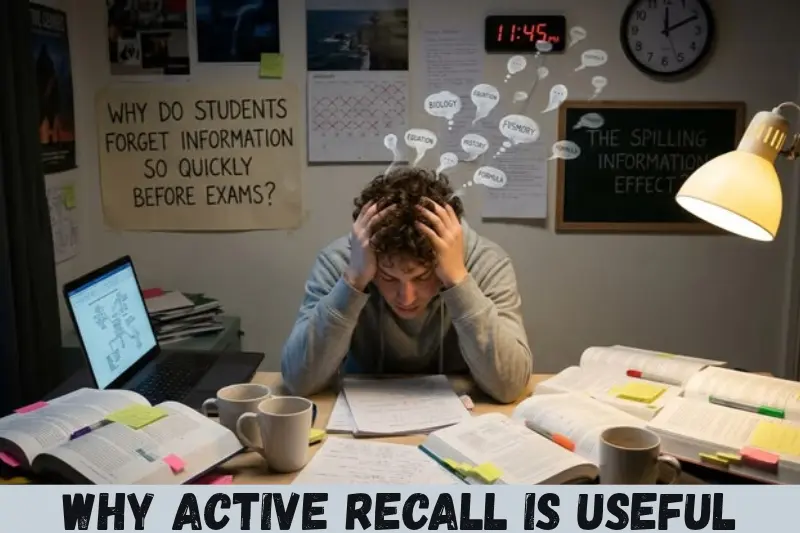
Active recall can help you identify knowledge gaps before the examination. It also gives you practice retrieving information, which is the skill you need when answering questions without access to your study materials.
The main challenge is that recall can initially feel more difficult than rereading. That difficulty is not necessarily a sign that the technique is failing. Use mistakes as feedback and revisit the information you could not remember.
4. Apply Spaced Repetition for Better Retention
Spaced repetition involves reviewing information across multiple sessions separated by time rather than trying to learn everything in one sitting.
This approach can help students revisit material before it becomes difficult to remember. It is especially useful for definitions, formulas, vocabulary, scientific terminology, and other information that requires repeated retrieval.
A Simple Spaced Repetition Schedule
You can start with this flexible example:
- Day 1: Learn a new topic and test your understanding.
- Day 2: Review the topic using questions or flashcards.
- Day 4: Test yourself again without looking at the answers.
- Day 7: Complete another short review.
- Before the exam: Test the most important concepts and revisit mistakes.
These intervals are an example, not a universal formula. Adjust them according to how difficult the material is, how well you remember it, and how much time remains before the examination.
How to Use Flashcards Effectively
Flashcards contain a question or prompt on one side and the answer on the other. They work best when you attempt to answer before revealing the solution.
For example:
Front: What is opportunity cost?
Back: The value of the next-best alternative given up when making a choice.
Create separate flashcards for confusing definitions, formulas, important dates, and concepts you repeatedly forget. Avoid putting entire textbook paragraphs on a single card.
5. Practise Previous Year Question Papers
Previous year question papers help you understand how a subject may be assessed. They can reveal common question formats, the level of detail expected, and the amount of time you may need for different types of questions.
For Indian college students, these papers may be available through university websites, college departments, faculty members, or official examination portals.
How to Use Previous Papers Properly
Follow a structured process:
- Collect relevant papers for your course and university.
- Check whether the syllabus or examination pattern has changed.
- Attempt questions without referring to your notes.
- Set a timer to practise working within the examination duration.
- Review your answers against reliable course materials or marking guidance.
- Record mistakes and revise the concepts behind them.
Do not simply memorize answers from old papers. A question may appear in a different format or test the same concept from another perspective.
What If Previous Papers Are Not Available?
Use textbook exercises, class assignments, sample papers, faculty-provided questions, and end-of-chapter problems.
You can also create your own practice questions from lecture headings. For example, convert a topic into a definition question, a short-answer question, and a longer analytical question.
This helps you prepare for different ways the examiner might assess your understanding.
6. Make Short and Useful Revision Notes
Revision notes should make important information easier to review. They are not meant to replace your textbook or reproduce every lecture word for word.
Good notes highlight essential ideas, relationships, formulas, examples, and common mistakes.
What Should Your Revision Notes Include?
Depending on your subject, include:
- Key definitions and concepts.
- Important formulas and their applications.
- Short summaries of major theories.
- Diagrams, flowcharts, and labelled illustrations.
- Comparisons between related concepts.
- Examples that clarify difficult ideas.
- Questions you answered incorrectly during practice.
For example, a biology student might create a labelled diagram and a short list of functions for a biological process. An economics student might summarize a theory, list its assumptions, and explain it using a practical example.
Avoid Making Notes Too Decorative
Colour coding and neat layouts can improve readability, but excessive decoration may consume valuable study time.
Use a simple format with headings, concise explanations, and consistent highlighting. If making notes takes longer than learning and practising the material, simplify your approach.
7. Use the Pomodoro Technique to Maintain Focus
The Pomodoro Technique is a time-management method that divides study time into focused work sessions followed by short breaks.
A common version uses 25 minutes of focused study followed by a five-minute break. After several sessions, you take a longer break. However, the ideal session length depends on your concentration, subject, and workload.
How to Use the Technique
- Choose one specific study task.
- Set a timer for 25 minutes.
- Study without checking unrelated notifications.
- Take a five-minute break when the session ends.
- Repeat the process and take a longer break after several sessions.
For example, you could dedicate one session to revising accounting formulas and another to solving practice problems.
If you prefer longer sessions, try 40–50 minutes of focused work followed by a 5–10-minute break. Choose a rhythm that allows you to concentrate without becoming exhausted.
What Should You Do During Breaks?
Stand up, stretch, drink water, walk around, or rest your eyes. Avoid activities that make it difficult to return to studying, such as getting absorbed in social media.
The purpose of a break is to recover your attention, not to create another distraction.
8. Study in an Environment That Supports Concentration
Your study environment can influence how easily you focus. A quiet, organized space with the materials you need can reduce interruptions and make it easier to begin working.
You do not need an expensive desk or a separate study room. A clean corner, a comfortable chair, and sufficient lighting may be enough.
Improve Your Study Environment
Try these practical adjustments:
- Keep textbooks, notebooks, and stationery within reach.
- Silence unnecessary phone notifications.
- Close unrelated browser tabs.
- Use headphones or quiet background sounds if they help you concentrate.
- Maintain comfortable lighting and ventilation.
- Keep water nearby.
- Tell family members or roommates when you need uninterrupted study time.
If you study in a hostel, library, or shared room, choose the quietest available location and use a consistent routine.
Should You Study With Music?
It depends on the task and your personal response to music. Instrumental music may feel comfortable for some students, while lyrics can distract others during reading or writing.
Test different conditions and observe your concentration. For demanding tasks, such as understanding complex theories or solving unfamiliar problems, silence may be more suitable.
9. Explain Difficult Concepts in Simple Words
Explaining a topic in your own words is a useful way to check whether you understand it. If you cannot explain an idea without repeatedly reading the textbook, you may need to revisit its foundations.
One practical approach is commonly called the Feynman Technique. It involves simplifying an explanation, identifying gaps in your understanding, and refining the explanation until it becomes clear.
How to Apply This Method
Choose a difficult concept and follow these steps:
- Write the concept at the top of a page.
- Explain it as if teaching someone unfamiliar with the subject.
- Identify confusing terms or steps in your explanation.
- Return to your textbook or lecture notes to clarify those gaps.
- Rewrite the explanation using simpler language.
- Test yourself with an example or practice question.
For instance, if you are studying compound interest, explain how interest is calculated on both the original amount and accumulated interest. Then solve a numerical example to check whether your explanation is accurate.
This method is useful for conceptual subjects, but it should be combined with calculations, practical exercises, or exam-style answers when the subject requires them.
10. Practise Writing Answers Under Exam Conditions
Knowing the material and presenting it effectively in an examination are related but different skills. Practising written answers helps you organize your ideas, manage time, and respond to the question asked.
This is especially important for descriptive subjects, university theory papers, case studies, and analytical questions.
How to Improve Your Answer-Writing Skills
Start by reading the question carefully and identifying its instruction word.
Common instruction words include:
- Define: Give the precise meaning of a term.
- Explain: Describe how or why something happens.
- Compare: Identify relevant similarities and differences.
- Discuss: Present a balanced explanation of the main aspects.
- Evaluate: Examine evidence or arguments and reach a reasoned conclusion.
- Calculate: Show the relevant method and working where required.
Next, organize your response according to the question’s requirements.
For a longer theoretical answer, a useful structure is:
- A direct introduction or definition.
- Main points arranged under clear headings.
- Relevant examples, diagrams, or supporting explanations.
- A short conclusion where appropriate.
Follow your university’s examination instructions, expected answer format, and marking scheme rather than assuming that every question needs the same structure.
Review Your Own Answers
After completing a practice answer, check whether you addressed every part of the question. Look for missing concepts, incorrect facts, weak explanations, and unnecessary repetition.
If possible, ask a teacher or classmate to review an answer when you are unsure about its quality.
11. Use Digital Tools Without Becoming Dependent on Them
Digital tools can make revision more organized by helping you create flashcards, schedule sessions, access course materials, and practise questions.
However, tools are only useful when they support actual learning. Collecting apps, switching between platforms, and formatting digital notes can consume time without improving your understanding.
Useful Types of Study Tools
Consider using:
- Digital calendars: Plan study sessions and examination deadlines.
- Flashcard applications: Review definitions and concepts through retrieval practice.
- Document editors: Organize notes, summaries, and revision sheets.
- Spreadsheets: Track completed chapters, test scores, and recurring mistakes.
- Question banks: Practise problems and compare your answers with reliable solutions.
- Recorded lectures: Revisit explanations of difficult topics when the original material is available.
Choose a small number of tools that solve a specific problem.
Can Students Use AI Study Assistants?
AI study assistants can help generate practice questions, simplify explanations, or organize a revision schedule. However, their answers may contain mistakes, incomplete explanations, or information that does not match your university syllabus.
Verify important facts, formulas, and definitions using textbooks, official course materials, and guidance from your instructors.
Do not rely on automatically generated answers without checking them, particularly in subjects where accuracy is essential.
12. Revise According to Your Subject
Different subjects require different revision strategies. A method that works well for memorizing definitions may not be enough for solving numerical problems or writing analytical essays.
Match your revision activities to the skills your examination tests.
Science and Mathematics
For mathematics, physics, chemistry, and other problem-solving subjects:
- Understand the principles behind each formula.
- Practise solving questions without looking at worked examples.
- Show your calculations clearly.
- Review incorrect answers and identify the source of each mistake.
- Practise interpreting diagrams, graphs, and experimental results where relevant.
Memorizing formulas without understanding when to apply them can make unfamiliar questions difficult.
Commerce and Management
For accounting, economics, business studies, and management subjects:
- Learn essential definitions and concepts.
- Practise numerical questions where applicable.
- Compare related theories and business models.
- Use examples to explain abstract ideas.
- Practise case studies and longer answers.
Organize your revision around both conceptual understanding and the application of knowledge.
Arts and Humanities
For literature, history, political science, sociology, and related subjects:
- Understand major arguments and themes.
- Create timelines or concept maps when useful.
- Compare important theories, events, or interpretations.
- Practise structured answers with relevant examples.
- Learn how to support arguments with accurate evidence.
Avoid memorizing long answers word for word. Understanding the subject makes it easier to adapt your response to the question.
Computer Science and Information Technology
For programming and technical subjects:
- Practise writing code without copying examples.
- Explain algorithms and their steps.
- Solve problems involving debugging and logical reasoning.
- Review important terminology and technical concepts.
- Practise tracing program output and identifying errors.
Reading code alone is not always enough. Hands-on practice helps you determine whether you can apply what you have learned.
13. Manage Exam Stress With Healthy Habits
Exam stress can make it harder to concentrate, sleep, and organize your preparation. A balanced routine that includes rest, movement, meals, and realistic study goals can support your ability to prepare.
Feeling some nervousness before an examination is common. However, persistent or overwhelming distress deserves attention rather than being treated as a simple lack of discipline.
Practical Ways to Reduce Exam Stress
Break large tasks into smaller goals. Completing one manageable task at a time can make a lengthy syllabus feel less overwhelming.
Use a consistent routine. Regular study and rest periods can reduce the uncertainty associated with last-minute preparation.
Take short movement breaks. Walking or stretching can provide a change of pace during long study sessions.
Limit unhelpful comparisons. Other students may have different preparation levels, responsibilities, and learning needs. Focus on your own progress.
Use simple breathing exercises. Slow, comfortable breathing may help you settle when you feel tense. Do not force deep breaths if they feel uncomfortable.
Seek support when needed. Speak with a trusted friend, family member, teacher, college counsellor, or qualified professional if stress becomes difficult to manage.
The goal is not to eliminate every feeling of nervousness. It is to develop a preparation routine that remains manageable even when examinations feel challenging.
14. Get Enough Sleep Before Your Exams
Sleep is an important part of an effective revision routine because learning involves both acquiring information and retaining it. Sacrificing sleep to study for longer can leave you tired and make concentration and recall more difficult.
College students should avoid treating all-night study sessions as a regular examination strategy.
How to Protect Your Sleep During Exam Week
- Maintain a reasonably consistent sleep schedule.
- Finish demanding revision early enough to wind down before bed.
- Avoid unnecessary late-night screen use if it interferes with sleep.
- Prepare your examination materials the night before.
- Review important concepts in short sessions instead of starting entire chapters at midnight.
Adults generally need at least seven hours of sleep per night, although individual needs vary. Younger students may need more.
If you have a morning examination, prepare for it by adjusting your routine in advance rather than suddenly changing your sleeping hours the night before.
15. Eat Regularly and Stay Hydrated
Food and hydration support your general well-being during examination preparation. Skipping meals or relying entirely on caffeinated drinks can leave you feeling uncomfortable, tired, or distracted.
You do not need a special examination diet. Aim for regular, balanced meals that suit your needs and daily routine.
Simple Food and Hydration Tips
- Eat regular meals rather than routinely skipping breakfast or lunch.
- Include a variety of foods, such as vegetables, fruit, whole grains, pulses, and other protein sources.
- Keep water available during study sessions.
- Choose convenient snacks, such as fruit, nuts, or yoghurt, if they suit your diet.
- Avoid consuming excessive caffeine, particularly late in the day.
- Do not experiment with unfamiliar supplements or energy products immediately before an examination.
For students in India, practical options may include dal, roti, rice, vegetables, curd, fruit, eggs, or other familiar foods that fit their dietary preferences.
Keep your routine simple and focus on regular nourishment rather than expecting a particular food to produce instant improvements in memory.
16. Avoid Common Exam Revision Mistakes
Even students who spend many hours studying can struggle if their preparation methods are inefficient. Recognizing common mistakes can help you make better use of the time available.
Studying Only the Night Before
Last-minute cramming may help you review some information quickly, but it leaves little room for repeated practice or identifying knowledge gaps.
Better approach: Divide the syllabus into smaller sections and review them across multiple sessions whenever possible.
Highlighting Everything
Highlighting can draw attention to important passages, but it does not automatically show whether you can recall or apply the information.
Better approach: Highlight selectively, then close the book and test yourself.
Multitasking During Study Sessions
Switching between notes, messages, videos, and unrelated websites can interrupt concentration.
Better approach: Choose one task for each session and remove unnecessary distractions.
Ignoring Mistakes
Repeating questions you already know can feel productive while leaving important weaknesses unresolved.
Better approach: Maintain a mistake log containing the question, your incorrect approach, the correct method, and the concept to review.
Memorizing Without Understanding
Memorization can be useful, especially for definitions and essential facts, but it may not prepare you for application-based questions.
Better approach: Connect information with examples, explanations, and practice questions.
Creating an Unrealistic Timetable
Planning more study hours than you can realistically complete may create unnecessary pressure.
Better approach: Set achievable targets, include breaks, and revise your schedule according to your actual progress.
17. Follow a Practical Seven-Day Exam Revision Plan
A seven-day revision plan can help you organize the final week before an examination when you have already studied at least some of the syllabus. It is a sample structure rather than a guarantee that you can complete every subject in seven days.
Adjust the schedule to your examination dates, remaining chapters, and level of preparation.
Day 1: Assess Your Preparation
List all chapters and identify the topics you understand well, those that need revision, and those that remain difficult.
Create a priority list and schedule the most demanding topics first.
Day 2: Revise Difficult Concepts
Focus on your highest-priority topics. Read the relevant material, explain the concepts in your own words, and solve a few practice questions.
Record any mistakes that need further attention.
Day 3: Strengthen Subject Knowledge
Revise the next group of topics and use active recall to test information learned earlier.
Review definitions, formulas, theories, and examples as appropriate to the subject.
Day 4: Practise Exam Questions
Attempt previous papers, sample questions, or textbook exercises.
Pay attention to question instructions and practise writing answers within reasonable time limits.
Day 5: Review Weak Areas
Use your mistake log to identify recurring problems.
Return to difficult concepts and practise similar questions until you understand the correct approach.
Day 6: Complete a Timed Practice Test
Attempt a suitable practice paper under conditions similar to your examination.
Review the result honestly. Identify whether your main challenges involve knowledge, accuracy, time management, or answer presentation.
Day 7: Consolidate and Rest
Review short notes, essential definitions, formulas, and common mistakes.
Avoid starting large amounts of unfamiliar material unless it is necessary for your preparation. Organize your stationery, identification documents, examination timetable, and travel arrangements.
Finish your revision early enough to get adequate sleep.
18. What to Do on the Morning of the Exam
Your examination-day routine should help you arrive prepared and mentally organized. Avoid trying to learn the entire syllabus immediately before entering the examination hall.
Use the morning to reinforce familiar material and prepare practically for the exam.
A Simple Examination-Day Checklist
- Wake up with enough time to get ready without rushing.
- Eat a suitable meal and drink water.
- Review brief notes or key formulas if helpful.
- Check the examination time, venue, and travel arrangements.
- Carry the required identification and permitted stationery.
- Follow your university’s rules about electronic devices and permitted materials.
- Arrive according to the examination centre’s instructions.
Once you receive the question paper, read the instructions carefully. Plan your time according to the marks and expected effort for each question.
If you feel nervous, pause briefly, breathe comfortably, and begin with a question you understand well when the examination rules and question structure allow it.
Do not spend too long on a single difficult question at the expense of questions you can answer. If appropriate, move on and return later.
Frequently Asked Questions
1. What are the best exam review tips for college students?
The most useful strategies include creating a realistic timetable, using active recall, reviewing material at spaced intervals, practising previous papers, and correcting mistakes. Students should also prioritize difficult topics, take regular breaks, and get adequate sleep. The best combination depends on the subject, the examination format, and the amount of preparation time available.
2. How many hours should a college student study for exams?
There is no single number of study hours that works for every student. Your required study time depends on the syllabus, existing knowledge, examination dates, and personal responsibilities. Focus on completing specific learning goals and testing your understanding rather than measuring preparation only by hours spent studying.
3. How can I remember what I study for a long time?
Use active recall and spaced repetition to revisit information across multiple sessions. Test yourself without looking at your notes, check your mistakes, and review difficult concepts again later. Connecting information with practical examples and explaining it in your own words can also help you develop a stronger understanding of the material.
4. Is studying at night better than studying in the morning?
Neither time is universally better for every student. Some people concentrate more effectively in the morning, while others prefer studying later in the day. Choose study periods that fit your natural routine and responsibilities. Whichever schedule you use, protect your sleep and avoid sacrificing rest to extend revision hours.
5. How can I prepare for college exams in the last seven days?
Begin by assessing the syllabus and identifying your weakest areas. Divide the remaining time between revising important concepts, practising exam questions, and reviewing mistakes. Complete a timed practice paper if possible, then use the final day for concise revision and practical preparation. Avoid relying entirely on last-minute memorization, and prioritize adequate sleep.
Conclusion
Effective exam review tips for college students focus on learning strategically rather than simply studying for longer hours. A realistic timetable, active recall, spaced repetition, practice papers, concise notes, and regular self-testing can help you prepare more confidently.
Your preparation should also include subject-specific practice, a distraction-free environment, healthy habits, and enough sleep. Avoid common mistakes such as passive rereading, unrealistic schedules, and last-minute cramming whenever possible.
Start today by listing your subjects, identifying three topics that need the most attention, and scheduling your first focused revision session. Track your progress, correct your mistakes, and adjust your plan as you learn. Consistent, purposeful preparation is a more practical approach than waiting until the final night before an examination.