
Introduction
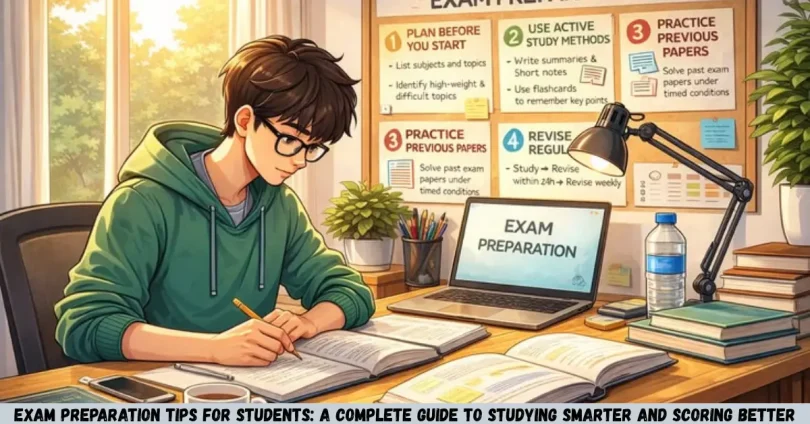
Exam preparation tips for students can make studying easier, improve understanding, and help students perform confidently in examinations. Whether you are preparing for school exams, board examinations, college tests, or competitive exams in India, following a structured study plan can help you use your time more effectively.
Many students spend long hours studying but struggle to remember important information, complete the syllabus, or manage exam stress. The solution is not always to study more hours. It is to study with a clear strategy, practise regularly, revise important concepts, and maintain healthy habits.
In this guide, you will learn how to create a realistic study timetable, improve concentration, remember information for longer, prepare for different types of exams, avoid common mistakes, and stay calm before and during examinations.
1. Create a Realistic Study Timetable
A study timetable helps students organise their subjects, track progress, and avoid last-minute preparation. Instead of deciding what to study every day, plan your sessions in advance according to your syllabus and exam dates.
How to Make an Effective Study Timetable

Follow these steps to build a practical study schedule:
- List all subjects: Write down every subject and the chapters included in the examination.
- Identify difficult topics: Mark subjects and chapters that require more attention.
- Set daily study goals: Decide which topics you will complete in each session.
- Include revision time: Reserve time to review previously studied material.
- Schedule breaks: Add short breaks between focused study sessions.
- Review your progress: At the end of each day, check what you completed and adjust the next day’s plan.
For example, a Class 10 student preparing for board examinations might study mathematics in the morning, science in the afternoon, and English in the evening. The exact schedule should depend on the student’s school timings, energy levels, and individual needs.
Example of a Daily Study Schedule
| Time | Activity |
|---|---|
| 7:00–8:00 AM | Revise difficult concepts |
| 9:00 AM–2:00 PM | School or coaching |
| 3:00–4:00 PM | Rest and refresh |
| 4:00–5:00 PM | Study mathematics or another challenging subject |
| 5:00–5:15 PM | Short break |
| 5:15–6:15 PM | Study science or another theory subject |
| 7:30–8:15 PM | Practise questions |
| 8:15–8:45 PM | Revise key points |
| Before sleeping | Prepare goals for the next day |
This is only an example, not a fixed routine. Students should adjust the timings to fit their responsibilities and concentration levels.
2. Understand Your Syllabus and Exam Pattern
Before starting exam preparation, understand what you need to study and how your knowledge will be tested. A clear understanding of the syllabus prevents students from wasting time on irrelevant topics.
Read the Syllabus Carefully
Obtain the latest syllabus from your school, college, examination board, or official exam website. Divide it into smaller topics and mark each topic as completed, in progress, or not started.
For Indian students, the preparation strategy may differ depending on the examination. CBSE and state board students should follow their prescribed syllabuses, while candidates preparing for competitive examinations should check the relevant exam authority’s official syllabus and instructions.
Check Previous Years’ Question Papers
Previous years’ question papers can help you understand question formats, difficulty levels, and how concepts are tested.
Use them to:
- Identify topics that you find difficult.
- Practise answering questions within a time limit.
- Understand the expected level of detail in written answers.
- Recognise areas where you need more revision.
Remember that previous papers are practice resources, not guarantees of what will appear in the next examination. Always prepare the complete prescribed syllabus.
3. Set Clear and Achievable Study Goals
Clear study goals make preparation more manageable. Instead of setting a vague target such as studying science for five hours, decide which chapters, concepts, or questions you want to complete.
Use Small Daily Targets
Break large tasks into smaller, measurable goals.
For example, your daily goals could include:
- Complete one chapter of mathematics.
- Revise two science topics.
- Solve 15 practice questions.
- Learn and review 10 important definitions.
- Attempt one section of a previous question paper.
Choose targets that are challenging but realistic. If you consistently fail to complete your timetable, reduce the workload and focus on steady progress rather than creating an unrealistic schedule.
Prioritise Your Weak Subjects
Students often spend more time studying subjects they already enjoy because the work feels easier. However, exam preparation should also address knowledge gaps.
Give additional attention to topics you do not understand, but continue revising your stronger subjects so that you do not forget previously learned material.
4. Use Active Recall to Remember More Information
Active recall is a study technique in which you try to retrieve information from memory instead of simply rereading it. It helps you identify what you genuinely understand and what needs more practice.
How to Practise Active Recall
Use the following method after studying a topic:
- Read and understand the topic carefully.
- Close your textbook or notes.
- Write down the main ideas from memory.
- Answer questions without looking at the answers.
- Check your responses and correct mistakes.
- Repeat the exercise later to strengthen your understanding.
For example, after studying the human digestive system, close your book and explain the digestive process in your own words. Then compare your explanation with your textbook and identify missing information.
This technique is useful for science, history, geography, business studies, and many other subjects.
5. Revise Regularly Instead of Studying Everything at the Last Minute
Regular revision helps students retain information and recognise concepts they have forgotten. Leaving all revision until the final days can create unnecessary pressure and reduce the time available for practising questions.
Follow a Spaced Revision Strategy
Spaced revision means reviewing information at intervals rather than repeating everything in one long session.
A simple revision plan could look like this:
- First review: Revise the topic shortly after learning it.
- Second review: Review it the next day.
- Third review: Test yourself again after several days.
- Fourth review: Revisit it after a week or according to your exam schedule.
These intervals are flexible. Difficult concepts may require more frequent practice, while familiar topics may need less attention.
Prepare Short Revision Notes
Short notes make it easier to review important information before an exam. Include:
- Key definitions and formulas.
- Important dates, events, or processes.
- Diagrams and labelled illustrations.
- Common mistakes and corrections.
- Important concepts that are easy to forget.
Avoid copying entire textbook chapters into your notes. The purpose is to create a concise resource that helps you recall the main ideas quickly.
6. Practise Mock Tests and Sample Papers
Mock tests allow students to practise exam-style questions under timed conditions. They also help identify weaknesses before the actual examination.
How to Use Mock Tests Effectively
For the best results, follow a consistent process:
- Choose a sample paper relevant to your examination.
- Set a timer based on the actual exam duration.
- Complete the paper without checking your notes.
- Mark your answers using a reliable answer key or marking scheme.
- Review every incorrect or incomplete answer.
- Practise the weak areas before attempting another paper.
Do not focus only on your score. Analyse why you lost marks. You may have misunderstood a concept, made a calculation error, misread a question, or spent too much time on one section.
Keeping a record of these mistakes can help you improve more effectively.
7. Improve Time Management During Exams
Time management is an important part of exam preparation because students need to demonstrate their knowledge within a limited period.
Practise Dividing Your Time
Before beginning a mock test, decide approximately how much time you can spend on each section. Keep a small amount of time for checking answers if the exam format allows it.
During the examination:
- Read the instructions carefully.
- Start with questions you understand, when the exam rules permit.
- Avoid spending too long on a single difficult question.
- Leave enough time for longer answers or calculations.
- Review your answers before submitting the paper.
For example, if a paper lasts three hours, you might plan to use the first few minutes to read instructions, allocate time to each section, and reserve the final minutes for checking. Adjust this plan according to the paper’s marks distribution and question types.
8. Find the Best Study Environment
Your study environment can affect concentration, comfort, and productivity. A suitable study space should reduce distractions and make it easy to access the materials you need.
Create a Distraction-Free Study Area
Choose a place with adequate lighting, comfortable seating, and enough space for books and stationery.
Try these practical improvements:
- Keep your phone away during focused study sessions.
- Turn off unnecessary notifications.
- Keep textbooks and notes organised.
- Study at a desk when possible.
- Inform family members when you need uninterrupted time.
- Use website blockers if online distractions are a problem.
You do not need an expensive study room. A quiet corner with the necessary materials can work well if it allows you to concentrate.
Limit Social Media Distractions
Social media can interrupt study sessions and make it difficult to return to a challenging topic. Set specific times for checking messages rather than repeatedly checking your phone.
If you use your phone for educational videos or online classes, keep the relevant learning material ready and avoid unrelated apps during the session.
9. Choose Study Techniques According to the Subject
Different subjects require different approaches. A technique that works well for memorising definitions may not be enough for solving mathematical problems.
Mathematics
Mathematics improves through understanding and regular problem-solving.
- Learn the reasoning behind formulas.
- Solve examples before attempting harder questions.
- Practise different question types.
- Show your working clearly.
- Review calculation errors and incorrect methods.
Memorising a formula without knowing when to use it can make unfamiliar questions difficult.
Science
Science preparation requires conceptual understanding, accurate terminology, and practice.
- Understand processes instead of memorising isolated sentences.
- Practise diagrams and labels.
- Learn formulas, units, and important definitions.
- Solve numerical problems where relevant.
- Explain scientific concepts in your own words.
For example, when learning electricity, understand the relationship between voltage, current, and resistance before repeatedly solving numerical questions.
English and Other Languages
Language examinations often assess comprehension, grammar, vocabulary, and written communication.
- Read passages and answer comprehension questions.
- Practise grammar exercises.
- Write essays, letters, and other required formats.
- Review spelling and punctuation.
- Learn how to organise answers clearly.
Regular writing practice is particularly useful because it helps you develop speed and express ideas accurately.
History and Geography
These subjects often require a combination of factual knowledge and explanation.
- Create timelines for historical events.
- Use maps to practise geographical locations.
- Connect causes with consequences.
- Organise longer answers using headings or clear paragraphs.
- Revise important terms, places, dates, and processes.
Understanding relationships between events and concepts is generally more useful than memorising disconnected facts.
10. Use Technology Wisely for Exam Preparation
Digital tools can support learning when they help you practise, organise, or understand your subjects. However, using more apps does not automatically lead to better preparation.
Useful Digital Study Resources
Students may benefit from:
- Official syllabus documents and sample papers.
- Online lectures from reliable educational sources.
- Digital flashcards for definitions and formulas.
- Calendar apps for study schedules.
- Practice quizzes and mock-test platforms.
- Online dictionaries and reference materials.
For Indian board and entrance examinations, verify that online resources match the current syllabus and exam pattern.
Avoid Passive Learning
Watching educational videos for hours may feel productive, but it does not always show whether you can apply what you learned.
After watching a lesson, solve questions, explain the concept without notes, or complete a short quiz. Active practice helps reveal whether you have understood the material.
11. Take Care of Your Health During Exam Preparation
Good study habits work best when combined with adequate sleep, regular meals, movement, and time to recover. Ignoring your physical needs can make concentration and memory more difficult.
Get Enough Sleep
Sleep supports learning, attention, and memory. Avoid regularly sacrificing sleep to study late into the night.
Teenagers generally need around 8–10 hours of sleep, while adults generally need around 7–9 hours. Individual needs vary, so build a routine that allows you to feel rested and alert.
Eat Balanced Meals and Stay Hydrated
Eat regular, balanced meals that provide energy throughout the day. Include foods such as fruits, vegetables, whole grains, pulses, and other suitable sources of protein.
Drink water regularly, especially during long study sessions. Avoid relying heavily on energy drinks or excessive caffeine to stay awake.
Include Physical Activity
Short walks, stretching, or other enjoyable physical activities can provide a useful break from studying.
You do not need an intensive exercise routine during exam season. Choose activities that fit your schedule and help you feel refreshed.
12. Manage Exam Stress and Build Confidence
Exam stress is common, especially when students face demanding syllabuses, high expectations, or uncertainty about results. A practical plan can reduce avoidable pressure and make preparation feel more manageable.
Break Large Tasks into Smaller Steps
Looking at an entire syllabus can feel overwhelming. Instead, focus on the next achievable task.
For example, replace the thought “I must finish the whole science syllabus today” with “I will revise one chapter and complete 10 related questions.”
Completing small tasks gives you a clearer view of your progress and helps you decide what to do next.
Use Simple Relaxation Techniques
If you feel overwhelmed, pause briefly and try slow, comfortable breathing. Relax your shoulders, take a short walk, or speak with someone you trust.
Avoid comparing your preparation constantly with classmates. Different students have different strengths, starting points, and learning speeds.
If stress becomes persistent, seriously affects sleep or daily functioning, or feels difficult to manage alone, consider speaking with a trusted adult, school counsellor, or qualified mental health professional.
13. Prepare Differently During the Final Week
The final week before an examination should focus on revision, practice, and identifying important gaps rather than trying to learn everything from scratch.
Seven-Day Revision Plan
| Day | Main Focus |
|---|---|
| Day 1 | Review the syllabus and identify weak topics |
| Day 2 | Revise difficult concepts and key definitions |
| Day 3 | Practise mathematics or subject-specific problems |
| Day 4 | Revise theory topics, diagrams, or important facts |
| Day 5 | Attempt a timed sample paper |
| Day 6 | Review mistakes and revisit weak areas |
| Day 7 | Revise short notes, prepare materials, and rest |
Adapt this plan to the number of subjects, exam dates, and remaining syllabus. If several exams are scheduled close together, divide your time according to the requirements of each paper.
What to Avoid Before an Exam
Try not to:
- Start several large chapters without a clear plan.
- Stay awake all night.
- Depend entirely on predicted questions.
- Spend hours comparing notes with other students.
- Try unfamiliar study techniques at the last minute.
- Ignore meals, water, or rest.
A calm, focused revision session is often more useful than an exhausting attempt to cover every detail overnight.
14. What to Do on the Morning of the Exam
The morning of the examination should be about staying organised and mentally prepared. Avoid turning it into a stressful race to learn large amounts of new material.
Follow a Simple Exam-Day Routine
- Wake up with enough time to get ready comfortably.
- Eat a suitable breakfast if you normally eat in the morning.
- Review short notes, formulas, or key definitions.
- Check your admit card, identification, stationery, and other required items.
- Confirm the exam location and travel arrangements.
- Reach the examination centre according to the official instructions.
For Indian board and competitive examinations, always follow the current instructions issued by the relevant examination authority. Requirements for identification, stationery, reporting time, and permitted items can differ between exams.
15. Use Smart Answer-Writing Techniques
Knowing the material is important, but presenting your answers clearly also matters. Good answer-writing habits help you communicate your understanding and reduce avoidable mistakes.
Read Every Question Carefully
Pay attention to instruction words such as explain, compare, describe, calculate, and justify. These words indicate what the question expects.
If a question asks you to compare two concepts, explain the similarities and differences instead of writing two unrelated definitions.
Structure Your Answers Clearly
Where appropriate, use:
- A direct opening statement.
- Short paragraphs explaining the main points.
- Numbered steps for processes.
- Correct formulas and calculations.
- Neat, labelled diagrams when relevant.
- A brief conclusion for longer explanatory answers.
For numerical problems, show the required steps and units. For essay-style answers, organise your ideas logically and avoid unnecessary repetition.
Always follow the marking scheme and the specific instructions for your examination.
16. Common Exam Preparation Mistakes to Avoid
Students sometimes work hard but lose valuable time because their study methods are inefficient. Recognising these mistakes can help you improve your preparation.
Studying Without a Plan
Starting whichever subject feels easiest can lead to neglected topics. Use a realistic timetable and review your progress regularly.
Relying Only on Reading
Reading notes repeatedly can create a false sense of familiarity. Test yourself, solve problems, and write answers from memory to check your actual understanding.
Ignoring Mistakes in Practice Tests
Completing a mock paper without analysing errors limits its value. Identify why each answer was wrong and practise the underlying concept again.
Multitasking While Studying
Switching between books, messages, videos, and social media can interrupt concentration. Focus on one main task at a time.
Comparing Yourself With Other Students
Another student’s timetable may not suit your needs. Track your own improvement and make adjustments based on your performance.
Leaving Revision Until the Last Day
Last-minute preparation can increase stress and leave little time to address misunderstandings. Review topics regularly throughout the preparation period.
17. How to Stay Motivated Throughout Exam Season
Motivation naturally changes from day to day. Rather than waiting to feel motivated, develop a routine that makes it easier to begin studying.
Build Consistent Habits
Start with a manageable study session and gradually increase the workload if needed. Keep your daily goals visible and record completed tasks.
You can also reward yourself with a short break after completing a difficult chapter or practice test.
Track Your Progress
Use a simple checklist to monitor your syllabus.
| Study Task | Status |
|---|---|
| Understand the chapter | Completed / Pending |
| Make short notes | Completed / Pending |
| Practise questions | Completed / Pending |
| Review mistakes | Completed / Pending |
| Revise the topic again | Completed / Pending |
This method helps you identify unfinished work without relying on memory alone.
Remember That Progress Matters
You do not need to achieve perfect results in every study session. If a topic takes longer than expected, adjust your plan and continue.
Consistent preparation, honest self-assessment, and regular practice are more useful than trying to follow an ideal timetable that does not fit your circumstances.
18. Frequently Asked Questions
1. What are the best exam preparation tips for students?
The best exam preparation tips for students include creating a realistic timetable, understanding the syllabus, setting daily goals, practising active recall, revising at regular intervals, and solving sample papers. Students should also get sufficient sleep, take short breaks, and review their mistakes to improve understanding and exam performance.
2. How many hours should a student study every day?
There is no single number of study hours that suits every student. Study time depends on age, school workload, exam difficulty, preparation level, and individual concentration. Focus on completing meaningful tasks and practising regularly rather than counting hours alone. Include breaks and sufficient sleep to maintain a sustainable routine.
3. How can I remember what I study for exams?
To remember information for longer, test yourself without looking at your notes, revise topics at increasing intervals, and practise questions regularly. Explaining a concept in your own words can also reveal gaps in understanding. Avoid depending entirely on repeated reading, and revisit difficult information until you can recall and apply it accurately.
4. How can I prepare for exams in the last seven days?
Start by checking the syllabus and identifying your weakest topics. Divide the remaining days between concept revision, question practice, sample papers, and error correction. Review short notes and important formulas near the exam date. Avoid all-night study sessions and prioritise the topics that need attention while keeping enough time for rest.
5. How can I reduce exam stress and improve concentration?
Reduce exam stress by following a realistic study plan, dividing large tasks into smaller goals, and taking regular breaks. Keep your study area free from distractions, get sufficient sleep, and use simple relaxation techniques when you feel overwhelmed. If anxiety significantly affects your daily life, seek support from a trusted adult or qualified professional.
Conclusion
Effective exam preparation is not about studying continuously or memorising every page of a textbook. It is about understanding your syllabus, planning your time, practising actively, revising regularly, and learning from your mistakes.
The most useful exam preparation tips for students include setting achievable goals, using active recall, solving sample papers, managing exam time, maintaining healthy habits, and staying calm under pressure. These methods can support students preparing for school examinations, board exams, college assessments, and competitive tests in India.